
Here’s a question your GP has almost certainly never asked you: how strong is your grip?
Not your bench press. Not your squat. Not your VO2 max. Just your grip — the simple ability to squeeze something firmly with your hand. It sounds almost comically basic as a measure of health. And yet the research on grip strength is some of the most compelling and consistent in the entire field of ageing and longevity. Study after study, across populations, countries and decades, keeps arriving at the same finding: grip strength is one of the most powerful predictors of how long you will live, how independently you will live, and how many of the chronic diseases associated with ageing you will develop along the way.
This is not a fringe finding from a single obscure paper. A landmark study published in The Lancet followed nearly 140,000 adults across 17 countries and found that grip strength was a stronger predictor of cardiovascular mortality than systolic blood pressure. Let that sit for a moment. The thing your doctor measures at every appointment, the number that drives medication decisions and lifestyle conversations worldwide — grip strength outperformed it as a mortality predictor. And yet the dynamometer — the simple handheld device used to measure grip strength — is nowhere to be seen in most GP consulting rooms.
What grip strength actually measures
It would be easy to dismiss grip strength as a narrow, isolated measure — just the strength of the muscles in your hand and forearm. But that’s not really what’s being captured when researchers use it as a health marker. Grip strength is better understood as a proxy for overall musculoskeletal health and the systemic biological processes that underpin it.
The muscles of the hand and forearm are among the smaller muscles in the body, but they share the same fundamental biology as every other muscle group. They respond to the same anabolic hormones — testosterone, growth hormone, insulin-like growth factor — that drive muscle maintenance and growth throughout the body. They deteriorate through the same mechanisms of sarcopenia, the age-related loss of muscle mass and function that begins in the thirties and accelerates through the fifties and sixties without intervention. And they reflect the same nutritional, hormonal and inflammatory environment that determines the health of muscle tissue everywhere else.
In practical terms, this means that when researchers measure grip strength in a large population and find that lower grip strength is associated with higher rates of cardiovascular disease, diabetes, respiratory disease, cognitive decline and all-cause mortality, they are not suggesting that weak hands cause these conditions. They are observing that grip strength is a reliable window into the overall state of the musculoskeletal system — and that a body with poor grip strength is a body whose broader biological maintenance has been compromised in ways that increase vulnerability to disease.
There is also a direct functional dimension to grip strength that is separate from its role as a biomarker. The ability to grip, carry, hold and manipulate objects is fundamental to independent living. Opening jars, carrying shopping, lifting grandchildren, managing luggage, getting up from the floor, gripping a stair rail — all of these depend on hand and forearm strength in ways that become very apparent when that strength declines.
The numbers: what the research actually shows
The evidence on grip strength and health outcomes is extensive enough to deserve a closer look, because the associations are stronger and broader than most people would expect.
Cardiovascular disease is one of the most consistently documented associations. The Lancet study mentioned above — one of the largest of its kind — found that each 5-kilogram reduction in grip strength was associated with a 17 percent increase in cardiovascular mortality and a 16 percent increase in overall mortality. These are not trivial associations. They held up after adjusting for age, physical activity, smoking, education and a range of other confounders.
Diabetes risk is also strongly linked to grip strength. Lower grip strength is associated with higher rates of insulin resistance and type 2 diabetes, which makes biological sense given that skeletal muscle is the primary site of glucose uptake in the body. More muscle mass and better muscle quality means greater capacity to clear glucose from the bloodstream — reducing the pancreatic burden and the risk of metabolic dysfunction.
Cognitive decline and dementia have shown consistent associations with grip strength in longitudinal research. A study published in the Journal of Alzheimer’s Disease found that weaker grip strength was associated with faster cognitive decline and greater dementia risk over time. The mechanisms are still being investigated, but the connection likely involves shared pathways of inflammation, vascular health and overall biological ageing.
Hospitalisation and surgical outcomes are meaningfully predicted by grip strength. Patients with lower grip strength prior to surgery have consistently worse outcomes — longer hospital stays, higher rates of complications and slower functional recovery. This is now recognised formally in clinical medicine under the concept of frailty, of which grip strength is a core component, and pre-surgical grip strength assessment is increasingly used in major hospitals to identify patients who may need targeted intervention before an operation.
Falls and fracture risk are also associated with grip strength — partly through the direct functional role of grip in catching and stabilising the body during a trip, and partly through grip strength’s relationship with overall muscle mass and bone density.
When does grip strength start to decline — and how fast?
Grip strength peaks somewhere in the late twenties to early thirties for most people, then begins a gradual decline that accelerates noticeably in the fifties and sixties. The rate of decline is not fixed — it is strongly influenced by physical activity levels, nutrition, hormonal health and the presence or absence of chronic disease.
Research suggests that sedentary adults can lose grip strength at a rate of approximately one to three percent per year through their forties and fifties, with the rate increasing in later decades. People who remain physically active, and particularly those who engage in regular resistance training, show significantly slower rates of decline and often maintain grip strength well into their seventies and beyond that would be considered excellent for people decades younger.
The concept of sarcopenia — the progressive loss of muscle mass and function with age — is the underlying biology here. Sarcopenia begins earlier than most people realise, often in the late thirties, and proceeds silently without any obvious symptoms until the cumulative effect becomes functionally significant. Grip strength decline is one of the earliest and most measurable signs of sarcopenia in progress.
For people over 40, this creates both urgency and opportunity. The trajectory is not fixed. The rate of decline can be slowed dramatically with the right intervention, and meaningful improvements in grip strength are achievable at virtually any age — including in people in their seventies, eighties and beyond who have never done any specific strength training.
What a normal grip strength looks like — and how to measure it
Grip strength is measured clinically using a handheld dynamometer, which gives a reading in kilograms. Reference ranges vary by age, sex and hand dominance, but as a general guide, normative values for adults in their forties tend to sit around 40 to 55 kilograms for men and 24 to 35 kilograms for women, with these ranges declining gradually through subsequent decades.
If you don’t have access to a dynamometer, a simple practical test can give you a rough indication. The ability to hang from a bar with a full grip for 30 seconds or more suggests reasonable grip endurance. The ability to carry two moderately heavy bags of shopping — one in each hand — for several minutes without significant forearm fatigue suggests adequate functional grip strength. The farmer’s carry test, where you pick up a moderately heavy weight in each hand and walk with it for a set distance and time, is used by many Exercise Physiologists as a practical functional assessment that combines grip strength with core stability and walking mechanics.
An Exercise Physiologist can conduct a more formal grip strength assessment using a dynamometer as part of a broader functional capacity screen — giving you an objective baseline measure that can be tracked over time and used to guide training.
The causes of grip strength decline beyond ageing
While age is the primary driver of grip strength decline, several other factors accelerate the process in ways that are worth understanding — because most of them are modifiable.
Physical inactivity is the most significant accelerant. The principle of use it or lose it applies directly to grip strength, as it does to all aspects of muscle function. A sedentary lifestyle that doesn’t regularly challenge the grip through carrying, lifting or specific training will produce faster decline than an active one.
Poor nutrition — particularly insufficient protein intake — undermines the body’s ability to maintain muscle tissue throughout the body, including the hands and forearms. After 40, protein requirements for muscle maintenance are higher than most people realise, and many older adults are chronically under-consuming protein relative to what their muscles need.
Chronic inflammation, driven by poor sleep, chronic stress, excess visceral fat and an inflammatory diet, creates a biological environment that accelerates muscle breakdown and impairs the anabolic processes that maintain muscle mass. Grip strength is sensitive to this systemic inflammatory state in the same way that all skeletal muscle is.
Hormonal decline — particularly testosterone in men and oestrogen in women — reduces the anabolic drive that maintains muscle mass and strength. This is one of the reasons grip strength declines more steeply in the decade after menopause in women and through the fifties in men as testosterone production gradually falls.
Certain medications can also affect grip strength, including corticosteroids used for inflammatory conditions and some medications that affect nerve function. If you are on long-term medication and have noticed changes in your grip or upper limb strength, it’s worth raising this with your GP.
Specific hand and wrist conditions — carpal tunnel syndrome, arthritis, tendinopathy and previous fractures — can all directly reduce grip strength through pain, nerve compression or structural changes. These require specific clinical management rather than general training, and an Exercise Physiologist will work within whatever constraints these conditions impose.
How to train grip strength specifically
The encouraging reality is that grip strength is one of the more trainable physical qualities — it responds well to consistent stimulus and can improve meaningfully within weeks of beginning targeted training. And much of the best grip training doesn’t require any specialist equipment or dedicated sessions — it can be woven into training you’re already doing.
Farmer’s carries are arguably the single best grip strength exercise available. Pick up a pair of heavy dumbbells or kettlebells, stand tall, brace the core, and walk. The sustained isometric demand on the grip muscles — along with the whole-body stability challenge — makes this exercise exceptionally effective for building both grip strength and endurance. Start with a weight you can carry for 20 to 30 seconds and build from there. The goal over time is to carry heavier loads for longer distances.
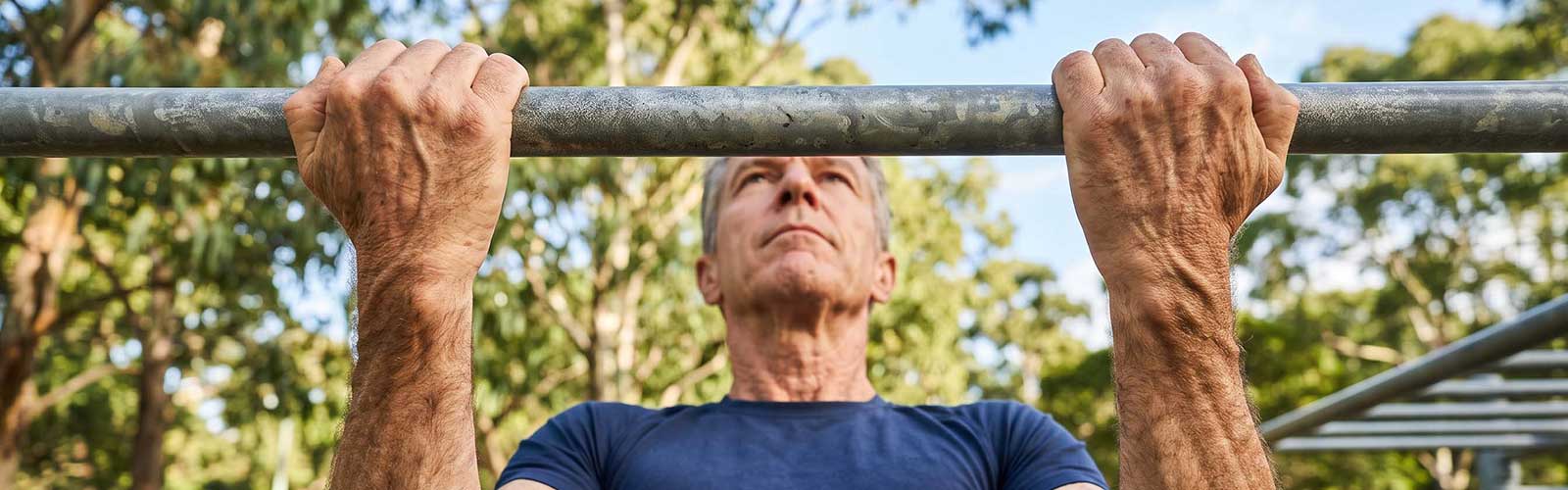
Dead hangs from a bar are another highly effective and underutilised tool. Simply hanging from a pull-up bar with both hands, supporting your full bodyweight, challenges the grip, the forearms, the shoulder girdle and the thoracic spine simultaneously. Even 10 to 20 seconds of dead hang performed regularly produces rapid improvements in grip endurance, and the traction through the shoulder joint has the side benefit of decompressing the glenohumeral joint — a welcome relief for anyone who sits at a desk all day.
Pull-ups, rows, and any pulling movement that requires the hands to bear load against resistance directly trains the grip alongside the larger back and arm muscles. Choosing to perform these exercises without lifting straps — which bypass the grip by attaching the wrist to the bar — ensures the grip is challenged alongside everything else.
Towel pull-ups and rope climbing, for those at a more advanced level, create a far greater grip challenge than standard bar work because the thicker diameter requires the hand to work harder to maintain contact. Even wrapping a towel around a dumbbell handle increases the grip demand of otherwise straightforward exercises.
Plate pinches — holding a weight plate between the thumb and fingers rather than wrapping the whole hand around a bar — specifically target the pinch grip and the muscles of the thumb, which are often underdeveloped. Hold a plate at your side for time, gradually progressing the weight.
Dedicated forearm and wrist work, including wrist curls, reverse wrist curls and wrist rotations with light resistance, directly targets the smaller muscles of the forearm that contribute to grip endurance and wrist stability. These are particularly relevant for people with desk-based jobs where repetitive typing and mouse use create imbalances in forearm muscle development.
For people with existing hand or wrist pain, an Exercise Physiologist will modify the approach to work around any restrictions while still progressively building grip capacity in a safe and structured way.
Grip strength and the bigger picture of healthy ageing
Grip strength sits within a broader conversation about muscle mass, functional capacity and what it actually means to age well — a conversation that Exercise Physiologists are particularly well placed to lead.
The medical model of ageing tends to focus heavily on the absence of disease as the definition of health. But for most people over 40, what they actually care about is the presence of capability — the ability to do the things that matter to them, for as long as possible, without help. That capability depends overwhelmingly on the health and function of the musculoskeletal system, and grip strength is one of its most accessible and informative measures.
When an Exercise Physiologist works with a client over 40 on a comprehensive strength and conditioning program, grip strength is rarely the primary focus of the conversation — but it gets trained almost automatically. Farmer’s carries, loaded pulls, heavy rows, deadlifts and carries all challenge the grip as part of their broader stimulus. The result is that clients who train consistently and progressively tend to maintain grip strength well above age-matched norms — and that advantage ripples outward into every health outcome that grip strength predicts.
If you’ve never thought about your grip strength before, you’re in good company. But now that you know what it’s telling the research community about long-term health, it might be worth paying it a little more attention.
At Inspire Fitness in Balwyn North, our Exercise Physiologists assess functional strength as part of every initial consultation — because knowing where you are is the first step to building a program that takes you where you want to go. If you’d like to find out more or book an assessment, we’d love to hear from you.