
If you’ve been diagnosed with arthritis, you’ve probably received some version of the same well-meaning advice: take it easy, don’t overdo it, rest the joint when it flares up. It’s intuitive advice. Painful joint, so stop moving it — that logic feels obvious. And yet it’s largely wrong, and following it too literally can quietly make things worse over months and years rather than better.
This isn’t a fringe opinion. It’s the position of every major arthritis clinical guideline in the world, including Arthritis Australia, the American College of Rheumatology and the World Health Organisation. Exercise — not rest — is now recognised as a first-line treatment for both osteoarthritis and inflammatory arthritis, sitting alongside or even ahead of many medications in terms of long-term impact on pain, function and quality of life. The challenge isn’t a lack of evidence. It’s that the evidence hasn’t caught up with intuition, and a lot of people are still quietly avoiding the very thing that would help them most.
What’s actually happening in an arthritic joint
To understand why exercise helps, it’s worth understanding what arthritis actually is — because the two main types work quite differently, and both respond well to movement for different reasons.
Osteoarthritis, the most common form, involves the gradual breakdown of the cartilage that cushions the ends of bones within a joint. As cartilage thins and the joint surfaces become less smooth, the joint can become painful, stiff and sometimes swollen, particularly with use. For a long time, osteoarthritis was thought of as a simple wear-and-tear condition — the more you use a joint, the faster it wears out, so rest was the logical protective response. That model has been substantially revised. Cartilage is living tissue that depends on movement for its nutrition. It has no direct blood supply, so it relies on the compressive and de-compressive forces of joint movement to pump nutrients in and waste products out — a process called imbibition. A joint that isn’t moved regularly doesn’t preserve its cartilage. It starves it.
Inflammatory arthritis, including rheumatoid arthritis and psoriatic arthritis, works through a different mechanism — the immune system mistakenly attacking the joint lining, causing inflammation, pain and, over time, joint damage if unmanaged. Here too, movement plays a valuable role, not by suppressing the underlying immune process — that’s the job of medication — but by maintaining the strength and function of the muscles surrounding the joint, preserving range of motion, and reducing the secondary de-conditioning that so often accompanies chronic inflammatory disease.
In both cases, the muscles surrounding a joint play a critical protective role. Strong, well-conditioned muscles absorb load, stabilise the joint through its range of motion, and reduce the direct compressive stress placed on the joint surfaces themselves. When those muscles weaken — which happens quickly with inactivity — more of the mechanical load falls directly onto the joint structures that are already compromised. This is one of the central reasons rest tends to backfire. It doesn’t protect the joint. It removes the very support system the joint depends on.
The vicious cycle of rest
Understanding what happens when someone with arthritis stops moving helps explain why the condition so often seems to worsen over time, even when nothing structurally dramatic has changed.
It typically starts with pain during a particular movement or activity — climbing stairs, gardening, a longer walk. The natural response is to avoid that movement to prevent the pain. In the short term, this works; avoiding the aggravating activity does reduce pain in that moment. But over weeks and months, avoidance has consequences. The muscles surrounding the joint weaken from disuse. The joint itself becomes stiffer as the tissues around it lose some of their normal pliability. Confidence in the joint declines, and movements that were once automatic start to feel effortful and uncertain.
The result is that the same activity — climbing those stairs, walking that same distance — now genuinely does hurt more, not because the arthritis has necessarily progressed structurally, but because the joint has lost the muscular support and movement capacity that once made that activity manageable. This reinforces the belief that movement is dangerous, prompting further avoidance, further de-conditioning, and a tightening spiral that can leave someone significantly more limited within a year or two than their actual joint pathology would predict.
This pattern has a name in pain science — it’s sometimes called the fear-avoidance cycle, and it’s one of the most well-documented psychological and physiological patterns in chronic pain and musculoskeletal conditions. Breaking it requires understanding that the pain experienced during movement is not always a direct signal of tissue damage occurring in that moment. For many people with arthritis, movement-related pain reflects sensitivity, stiffness and de-conditioning rather than active harm — and gradually, safely reintroducing movement is what actually resolves it.
What the research says about exercise and arthritis
The evidence supporting exercise for arthritis is substantial and consistent across a large body of research spanning decades.
For osteoarthritis, multiple systematic reviews and meta-analyses have found that structured exercise programs produce meaningful reductions in pain and meaningful improvements in physical function, with effect sizes that compare favourably to common pharmacological interventions. Strength training in particular has strong evidence for knee and hip osteoarthritis, with several studies showing that resistance training reduces pain and improves function as effectively as, or more effectively than, common anti-inflammatory medications — without the gastrointestinal, cardiovascular and renal side effects that come with long-term anti-inflammatory use.
For rheumatoid arthritis and other inflammatory conditions, exercise has been shown to improve cardiovascular fitness, muscle strength and functional capacity without increasing disease activity or joint damage, provided the program is appropriately designed around disease activity and flare status. This finding has been particularly important in shifting clinical practice, because for many years people with inflammatory arthritis were actively discouraged from resistance training out of concern it would worsen joint damage. The evidence simply doesn’t support that concern when exercise is properly prescribed.
Exercise also delivers benefits well beyond the joint itself. People with arthritis who exercise regularly show improvements in mood, sleep quality, fatigue levels and overall quality of life — all of which are commonly affected by chronic joint pain and are worth addressing in their own right.
Understanding pain during exercise: what’s normal and what’s not
One of the biggest barriers to exercise for people with arthritis is uncertainty about what level of discomfort during activity is acceptable, and what signals a genuine problem. This is a completely reasonable concern, and getting clarity on it removes a lot of the fear that keeps people inactive.
A widely used and clinically supported guideline is the traffic light system. Pain that sits in the mild to moderate range during exercise — something you’d rate as a two to five out of ten — and that settles back to baseline within a couple of hours after finishing is generally considered acceptable and expected, particularly when starting a new exercise or progressing load. This is your body adapting to a new demand, not a sign of damage occurring.
Pain that climbs into a higher range during exercise, or that persists at an elevated level for more than 24 hours afterward, suggests the dose was too much for that session and the load should be reduced next time. Sharp, sudden pain, joint swelling that increases significantly after exercise, or pain accompanied by joint instability are signals to pause and seek professional assessment.
This framework gives people permission to exercise through some discomfort — which is often necessary and appropriate — while still maintaining sensible boundaries around what constitutes overdoing it. Without this kind of guidance, many people either avoid exercise entirely out of fear of any pain at all, or push through genuinely excessive pain because they’ve been told “no pain, no gain” without the nuance that arthritis management actually requires.
The case for progressive loading
Progressive loading is the principle that underlies almost all effective exercise prescription, and it is particularly important — and often misunderstood — in the context of arthritis.
The concept is straightforward. You start with a load, whether that’s bodyweight, a light resistance, or a modest range of movement, that the joint and surrounding tissues can currently tolerate without excessive symptom flare. You perform that load consistently, allowing the tissues to adapt — muscles strengthen, tendons and ligaments become more resilient, and the joint itself becomes more accustomed to bearing load through movement. Once that level feels manageable and symptoms are stable or improving, the load is gradually increased, and the adaptation process repeats at the new level.
This is fundamentally different from either extreme that people often default to. It’s different from complete rest, which provides no stimulus for adaptation and allows de-conditioning to proceed unchecked. And it’s different from pushing through pain indiscriminately, which can genuinely aggravate symptoms and undermine confidence in the process. Progressive loading occupies the middle ground — enough stimulus to drive genuine adaptation, calibrated carefully enough to avoid excessive flare-ups, adjusted continuously based on how the individual is responding.
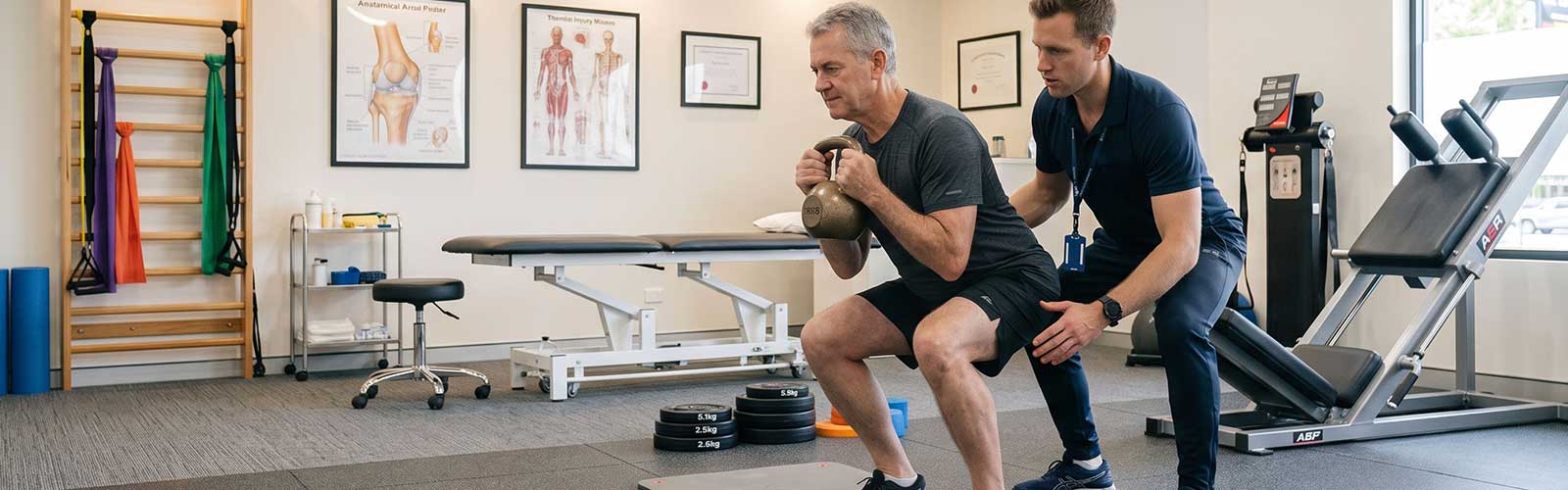
For someone with knee osteoarthritis, this might mean starting with body-weight sit-to-stands from a slightly raised chair, progressing over weeks to a standard chair height, then to a lower surface, then to adding external load through a weighted vest or holding dumbbells. For someone with hip arthritis, it might mean beginning with supported hip abduction and gentle range of motion work, progressing gradually toward resisted movements and eventually functional patterns like step-ups and single-leg work. The specifics vary enormously depending on the joint involved, the severity of the condition, and the person’s starting point — which is exactly why individualised guidance matters so much in this space.
The role of strength training specifically
Of all the forms of exercise relevant to arthritis, resistance training deserves particular emphasis, because its role in joint protection is often under-appreciated even among people who have embraced the idea of exercise more generally.
Strong muscles function as a joint’s primary shock absorbers and stabilisers. For the knee, strong quadriceps and hamstrings control the alignment and loading pattern of the joint through every step, squat and stair climb. For the hip, strong glutes and hip stabilisers control pelvic alignment and reduce excessive stress through the joint during walking and standing. For the hands, which are commonly affected by both osteoarthritis and rheumatoid arthritis, maintaining grip and forearm strength preserves function for the countless daily tasks that depend on hand dexterity and strength.
Resistance training also has systemic anti-inflammatory effects that are relevant to arthritis management, particularly inflammatory forms. Regular strength training has been shown to reduce circulating inflammatory markers over time, contributing to a biological environment less conducive to disease progression, alongside whatever medical management is being used to control the underlying condition.
The prescription doesn’t need to be extreme to be effective. Two sessions per week of well-structured resistance training targeting the major muscle groups, with particular attention to the muscles surrounding the affected joint, is sufficient to produce meaningful improvements in strength, function and pain over a period of eight to twelve weeks for most people. Consistency and appropriate progression matter more than intensity or volume.
Aerobic exercise and joint-friendly options
Aerobic exercise also plays an important role in arthritis management, supporting cardiovascular health, weight management and overall function, while offering some specific benefits for joint health through improved circulation and reduced systemic inflammation.
For people with significant joint pain, particularly in weight-bearing joints like the hips and knees, lower-impact options are often the most sustainable starting point. Swimming and water-based exercise are particularly valuable because the buoyancy of water substantially reduces joint loading while still allowing a genuine cardiovascular and strength stimulus. Cycling, whether on a stationary bike or outdoors, loads the joints in a smooth, controlled way without the repetitive impact of walking or running, making it accessible for many people with knee and hip arthritis. Walking remains an excellent option for many people and shouldn’t be avoided out of excessive caution — for most people with mild to moderate osteoarthritis, walking is well tolerated and genuinely beneficial, particularly when paced sensibly and combined with supportive footwear.
The right choice depends heavily on the individual joint involved, the severity of symptoms, and personal preference — because the best form of aerobic exercise, as with most things in fitness, is the one you’ll actually do consistently.
Weight management and its impact on joint load
It’s worth addressing the relationship between body weight and joint loading directly, because it’s a significant factor for many people managing arthritis, particularly in the knees and hips.
Every kilogram of body weight translates into several kilograms of additional load through the knee joint during walking, and considerably more during activities like climbing stairs or descending a slope. This means that even modest reductions in body weight can produce meaningful reductions in joint loading and, correspondingly, meaningful reductions in pain for people carrying excess weight. Research has consistently shown that weight loss of even five to ten percent of body weight can produce clinically significant improvements in knee osteoarthritis symptoms.
This is where the combination of resistance training and aerobic exercise becomes particularly powerful, because it simultaneously builds the muscular support that protects the joint while supporting the metabolic changes that facilitate healthy weight management, creating a genuinely compounding benefit over time.
Why working with an Exercise Physiologist matters
Arthritis management through exercise is not something that responds well to generic, one-size-fits-all programming. The right starting point, the right progression rate, the right exercise selection and the right load calibration depend heavily on which joints are affected, the severity and type of arthritis, other health conditions, previous injury history, and how the individual responds to different types of loading.
An Accredited Exercise Physiologist brings the clinical expertise to navigate all of this. They can assess your current joint function, muscle strength and movement patterns, identify which specific exercises are likely to be well tolerated and which may need modification, and build a program that progresses at a pace matched to how your body is actually responding — not a fixed template that ignores your individual presentation.
Just as importantly, an Exercise Physiologist provides the confidence and reassurance that so many people with arthritis need to overcome the fear of movement. Understanding that the pain you’re feeling during a particular exercise is expected and safe, rather than a sign of damage, often requires the guidance of someone who can interpret your symptoms accurately and adjust the program appropriately in response.
At Inspire Fitness in Balwyn North, we work with people managing all forms of arthritis every week, and one of the most common things we hear once a program is underway is genuine surprise at how much better a joint can feel once it’s being loaded appropriately, rather than avoided. If you’ve been told to rest and you’re not seeing the improvement you hoped for, it might be time for a different approach.
Your joints were built to move. Given the right kind of loading, most of them are far more capable than fear allows people to believe.