
Understanding Patellofemoral Pain and What to Actually Do About It.
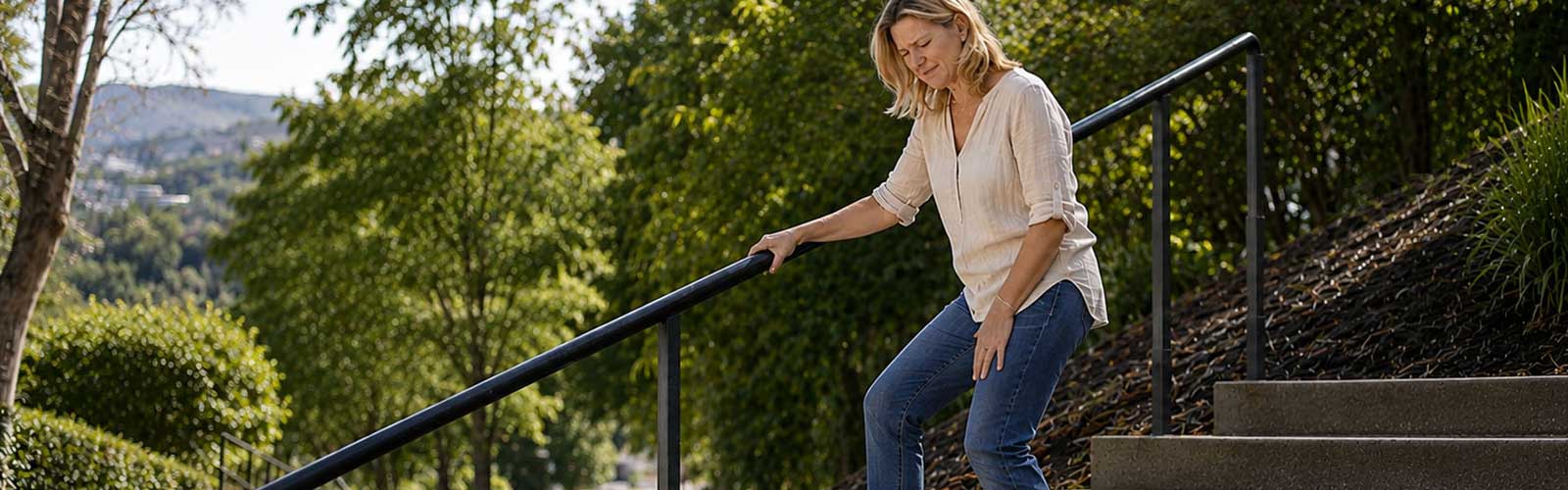
There’s a particular kind of frustration that comes with front-of-knee pain. It’s not dramatic enough to send you to emergency. It doesn’t stop you in your tracks the way a torn muscle does. But it shows up — reliably, stubbornly — whenever you walk down stairs, sit for too long, squat down to pick something up, or try to do the run or sport that you’ve been doing for years without a second thought. You rest it. It gets better. You start moving again. It comes back.
If that sounds familiar, you’re in very good company. Patellofemoral pain syndrome — pain at the front of the knee, around or behind the kneecap — is one of the most common musculoskeletal complaints in active adults over 40. And it’s also one of the most misunderstood and mismanaged. Most people either push through it and make it worse, or stop everything they enjoy and wait for it to magically resolve. Neither approach works particularly well.
Let’s take a look at what’s actually going on, why it’s so common in this stage of life, and — importantly — what a genuinely effective approach to addressing it looks like.
What Is Patellofemoral Pain Syndrome, Actually?
The kneecap — the patella — isn’t just sitting there looking decorative. It’s a sesamoid bone that sits within the tendon of the quadriceps and slides up and down in a groove at the front of the femur (your thigh bone) as your knee bends and straightens. When everything is working well, this movement is smooth and painless. When it’s not, the kneecap tracks unevenly in that groove, and the pressure on the cartilage behind it increases — sometimes significantly.
Patellofemoral pain syndrome (PFPS) is the umbrella term for pain arising from this area. It’s sometimes called “runner’s knee,” though that nickname undersells how broadly it affects people — runners, cyclists, hikers, tennis players, gym-goers and people who simply use stairs. The pain is typically felt at the front of the knee, often described as aching, sharp with certain movements, or a grinding sensation. It tends to be provoked by activities that load the kneecap — going downstairs is a classic trigger, as is squatting, sitting for extended periods with the knee bent (the so-called “theatre sign”), running downhill, or getting up from a low chair.
It’s worth saying clearly: PFPS is not the same as arthritis, though the two can coexist. It’s not a structural tear. And despite how frustrating it is, it’s highly manageable — often very effectively — with the right approach.
Why Is This So Common After 40?
The short answer is that several things converge around this time of life in a way that loads the patellofemoral joint beyond what it’s accustomed to.
Muscle balance shifts with age. The quadriceps — particularly the VMO, the teardrop-shaped muscle on the inner side of the knee — tends to weaken relative to the lateral structures of the thigh and hip as we get older and less active. This imbalance pulls the kneecap slightly off its ideal tracking path, increasing pressure on the cartilage. Separately, hip abductor and external rotator strength — the muscles of the outer hip and glutes — plays a surprisingly large role in how the knee loads during activity. Weakness here allows the thigh to drop inward, which shifts the angle of force through the kneecap in a way that dramatically increases stress.
At the same time, soft tissue adaptability declines. The iliotibial band and lateral retinaculum — the connective tissue structures on the outer side of the knee — can become tighter over time, pulling the kneecap laterally and compounding the tracking problem. Cartilage, which has poor blood supply and limited ability to self-repair, is slower to tolerate load spikes and recovers more slowly from periods of overuse.
Then there’s the training load factor. Many people over 40 ramp up activity after a period of relative inactivity, or return to sport after time off, and load the knee faster than the surrounding tissues can adapt. The knee starts complaining, people rest, then return to the same pattern — and the cycle repeats.
There’s also a biomechanical story worth understanding. The way we move — our running gait, our squat pattern, the way our foot strikes the ground — can drive patellofemoral stress in ways that aren’t obvious without a trained eye. Excessive foot pronation, a narrow running stance, or a forward trunk lean that shifts load to the knee rather than the hip are all common patterns that quietly accumulate stress on the kneecap over years of activity.
What Doesn’t Work – And Why People Keep Trying It
Before getting to what does work, it’s worth naming the approaches that don’t — because most people with PFPS will have tried at least a couple of them.
Resting completely is the most intuitive response and the least effective long-term strategy. Pain does tend to improve with rest, which reinforces the behaviour. But the underlying causes — muscle weakness, poor tracking, movement pattern issues — remain entirely unaddressed. The knee feels fine, activity resumes, the same forces are applied, and the pain returns, often faster than the first time.
Anti-inflammatories manage symptoms but don’t change anything about why the symptoms exist. They have a role in short-term pain management during the early stages of a flare-up, but relying on them as a primary treatment is a holding pattern, not a solution.
Generic exercise programs downloaded from the internet often miss the mark because PFPS is not a single, uniform problem. Two people can have identical symptoms and completely different underlying drivers — one may have a hip weakness issue, another a foot mechanics issue, another a training load problem. A generic quad-strengthening program may help one and do little for the other.
Knee braces and taping are useful adjuncts that can reduce pain during activity, and kinesiology taping in particular has good evidence for short-term symptom relief. But like rest and medication, they don’t address what’s driving the problem.
What Actually Works
The evidence base for PFPS management has grown substantially over the past decade, and the picture that emerges is fairly consistent: a targeted, progressive strength and load management program — particularly one that addresses hip and quadriceps strength in combination — produces the best long-term outcomes. The keyword here is targeted. The specific exercises matter less than ensuring they’re addressing the right deficits for the individual.
Hip-focused exercise is where many people are surprised. Strengthening the glutes, hip abductors and external rotators consistently reduces patellofemoral pain in studies even when the program includes little direct knee work. This works because a stronger, more stable hip controls the position of the thigh, which directly changes the tracking of the kneecap. Exercises like clamshells, lateral band walks, single-leg bridges and hip-hinge variations are not glamorous — but they are highly effective.
Quadriceps strengthening, when done in ranges of motion that don’t provoke pain, is equally important. The VMO in particular responds well to exercises performed in the terminal range of knee extension — that last 30 degrees or so of straightening — and to single-leg work that demands coordination alongside strength. The key is progressing load gradually enough that symptoms don’t flare.
Movement retraining is the piece that often gets overlooked. If someone runs with a pattern that drives excessive knee loading, or squats in a way that repeatedly stresses the kneecap, strengthening alone won’t fully resolve the problem. Gait analysis, movement assessment and cued technique changes are a meaningful part of a complete solution.
Load management — the thoughtful adjustment of how much activity you’re doing and at what intensity — is not the same as rest. It means finding the level of activity that keeps you moving without provoking the knee past its current tolerance, and then gradually building from there.
Why Working With an Exercise Physiologist Changes the Outcome
Most people who’ve had PFPS for any length of time have done some version of self-management. They’ve Googled it, watched YouTube videos, tried the exercises. And many find that results are inconsistent — things improve for a while, then regress, or certain exercises help while others inexplicably make things worse.
This is where working one on one with an exercise physiologist makes a genuine difference. At Inspire Fitness, when we sit down with a client who has patellofemoral pain, we’re not starting from a template. We’re building a picture of that specific person — their history, their activity, their goals, how their pain behaves, where the deficits are when we actually assess their movement and strength. That assessment shapes everything that follows.
The program we build together is designed around what’s actually driving their problem, not what drives the average person’s problem. It progresses at a rate matched to their tissue tolerance — fast enough to make real change, measured enough to avoid flare-ups that set progress back. And when something isn’t working as expected, we adjust. That iterative, responsive process is something a YouTube video simply cannot replicate.
For people who’ve been managing PFPS for years and resigned themselves to it being permanent, this is worth hearing: that outcome is not inevitable. With the right program, the right progression and proper attention to the underlying drivers, most people with patellofemoral pain achieve significant and lasting improvement.
Practical Things You Can Do Right Now
While working with a professional is the gold standard, there are some evidence-informed steps worth starting on immediately.
Modify your load, don’t eliminate it. Identify which activities provoke the pain most reliably and temporarily reduce the volume and intensity of those specifically. Maintain your overall activity level with lower-pain alternatives like swimming or cycling if running is irritating the knee.
Pay attention to how long you sit with your knee bent. Getting up and straightening the knee regularly can reduce the aching that builds with prolonged sitting — a small change that makes a noticeable difference for many people.
Start some hip work. Adding basic glute and hip abductor exercises to your routine is unlikely to do harm and quite likely to help. Single-leg bridges, lateral band walks and clamshells are simple starting points that require no equipment.
Look at your footwear. Worn-out running shoes or completely unsupportive footwear can contribute to the mechanics that load the patellofemoral joint. An easy and inexpensive variable to rule out.
And then — get a proper assessment. Without knowing what’s actually driving your pain, you’re working with incomplete information. A targeted approach will always outperform a general one.
The Long View
Knee pain that keeps coming back is the body’s way of saying that something in the system isn’t quite right. It’s not a sign that you need to stop being active — if anything, the right activity is part of the solution. It’s a signal that the way you’re loading your body needs some adjustment.
The people who do best with patellofemoral pain over the long term are the ones who treat it as information rather than an obstacle. They use it as an entry point into understanding their body better — their weaknesses, their movement habits, their training patterns — and they come out the other side not just pain-free, but moving better than they were before the pain started.
That’s a genuinely achievable outcome. And it starts with getting the right information about your specific situation.
If you’ve been living with front-of-knee pain and you’re ready to actually address it rather than manage around it, we’d love to help. At Inspire Fitness, we work one on one with each client to understand and address exactly what’s driving their pain — and build them back toward everything they want to do. Reach out and let’s have a conversation about what that looks like for you.