
The advice most people get — and why it’s incomplete
If you’ve ever mentioned pelvic floor concerns to a health professional and walked away with the advice to “just do your Kegels,” you’ve been given a small piece of a much bigger picture. It’s well-meaning advice, and Kegels certainly have their place, but reducing pelvic floor health to a single squeeze-and-hold exercise is a bit like trying to build total-body strength with only bicep curls. Technically you’re doing something — but you’re leaving a lot on the table.
The good news is that pelvic floor training, when approached properly, is far more interesting and effective than most people realise. And for people over 40, getting it right can make a meaningful difference to quality of life, confidence in exercise, and long-term independence.
What the pelvic floor actually does
The pelvic floor is a group of muscles that sit at the base of your pelvis, forming a supportive sling between your pubic bone and your tailbone. These muscles have several important jobs. They support your pelvic organs — including the bladder, bowel and uterus — stabilise your pelvis during movement, and play a central role in maintaining bladder and bowel control. They also contribute to sexual function and work as part of the body’s broader core system alongside the diaphragm, deep abdominal muscles and spinal stabilisers.
That last point is worth dwelling on. The pelvic floor doesn’t operate in isolation. It is a dynamic, integrated component of what is often called the “true core” — a system of deep muscles that work together to manage pressure within the abdomen and provide stability during everything from a heavy deadlift to a simple cough. When one part of that system isn’t functioning well, the others compensate, and that’s often where problems quietly begin.
Why Kegels alone aren’t enough
Kegels are essentially repeated contractions of the pelvic floor muscles. They’re useful for building basic strength in these muscles, and for many people they’re a necessary first step. But strength alone is not the full picture of pelvic floor function.
A well-functioning pelvic floor needs four things: strength, endurance, coordination and the ability to relax. That last one surprises a lot of people. Many assume that pelvic floor problems are always caused by weakness and that the answer is always to contract more. But for a significant number of people — particularly those who carry tension through the pelvis, have experienced trauma, or have been overdoing their Kegels — the issue is actually too much tension, not too little. In those cases, more squeezing is not only unhelpful, it can actively make things worse.
There are also several common errors people make when attempting pelvic floor training on their own. Using the wrong muscles — gripping the glutes, squeezing the inner thighs, or bracing the superficial core instead — is extremely common and means the effort isn’t reaching the right place at all. Breath holding during contractions is another frequent mistake, and an important one, because the breath and the pelvic floor are intimately connected. Contracting without fully releasing afterward is also problematic, as is training the pelvic floor in isolation without ever applying it to the movements that actually matter in daily life.
Learning to contract and relax correctly
The foundation of any good pelvic floor program is learning how to correctly contract and relax these muscles — and for many people, this step alone requires more attention and guidance than they expect.
A healthy pelvic floor should be able to contract on demand — when lifting, coughing, sneezing, jumping or exercising — and then fully release when that demand passes. When going to the toilet, for example, the pelvic floor needs to let go completely. The ability to relax is just as important as the ability to contract, and training both is essential for balanced pelvic floor function.
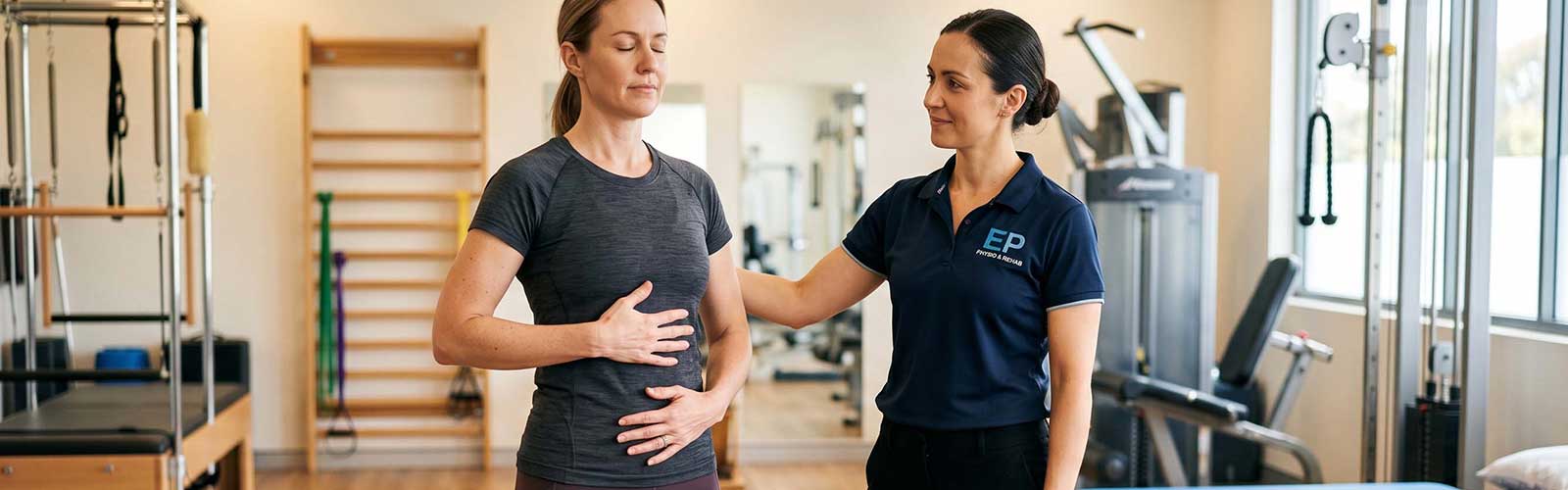
At Inspire Fitness, this is where we begin. Rather than handing someone a generic set of Kegel instructions and sending them on their way, we take the time to ensure that the right muscles are activating correctly, that the release is as complete as the contraction, and that the whole thing is happening without unnecessary breath holding or compensatory tension elsewhere in the body. Like any other form of exercise, we prescribe specific repetitions, sets, hold times and contraction intensities based on individual needs and goals — because what’s appropriate for one person may be quite wrong for another.
The role of breathing
One of the most overlooked aspects of pelvic floor training is its relationship with breathing, and this is something we place a strong emphasis on at Inspire Fitness.
The diaphragm and the pelvic floor move in coordination with every breath you take. As you inhale, the diaphragm descends and the pelvic floor naturally relaxes and lowers slightly in response to the increased abdominal pressure. As you exhale, the diaphragm rises and the pelvic floor gently lifts and contracts. This coordinated rhythm happens automatically in a well-functioning system, but in many people — particularly those with pelvic floor dysfunction, chronic tension, or a history of breath holding during exercise — this natural coordination has broken down.
Restoring it is not complicated, but it does require deliberate attention. Learning to exhale on the effort phase of an exercise — breathing out as you lift, push, or exert — naturally recruits the pelvic floor at the right moment and reduces the pressure spikes that can contribute to leaking or prolapse symptoms. Once this becomes habitual, it fundamentally changes the way the whole core system functions during exercise and daily activity.
Integrating pelvic floor training into functional movement
This is the stage that most generic pelvic floor programs never reach — and it’s arguably the most important part.
Training the pelvic floor in isolation, lying on a bed doing Kegels, is a starting point. But the pelvic floor doesn’t operate in isolation in real life. It needs to respond automatically and appropriately during squatting, lifting, walking, running, sneezing, laughing and every other demand your daily life places on it. If it has only ever been trained in a controlled, static position, it is unlikely to perform reliably when real-world demands arise.
At Inspire Fitness, we progressively integrate pelvic floor engagement into functional movement patterns. This means gradually introducing pelvic floor activation into exercises like squats, hinges, step-ups and carries — movements that mirror what you actually do in daily life. Over time, load is increased, complexity is added, and where appropriate, impact-based training is introduced. This might mean progressing from a simple bodyweight squat with breath coordination, to a loaded goblet squat, to a split squat, and eventually to movements that involve a landing or change of direction — depending on what the individual needs and is working toward.
For someone whose goal is to return to running without leaking, the program looks different to someone who wants to lift heavier weights at the gym, or a new mother working to rebuild her core and pelvic floor after childbirth, or an older adult focused on maintaining continence and confidence with daily tasks. The principles are the same — correct activation, full relaxation, breath coordination, progressive functional integration — but the application is highly individual.
What this means for people over 40
After 40, a number of factors converge that make pelvic floor training increasingly relevant regardless of gender. Hormonal changes — particularly the decline in oestrogen through perimenopause and menopause — affect the elasticity and tone of pelvic floor tissues in women, contributing to increased vulnerability to leaking, prolapse and pelvic pain. For men, prostate health and changes in pelvic floor tone can affect bladder control and sexual function. And for both, the general decline in muscle mass and neuromuscular coordination that accompanies ageing means that the pelvic floor, like every other muscle group, benefits significantly from deliberate, progressive training.
The encouraging reality is that pelvic floor dysfunction is not something that simply has to be accepted as an inevitable part of getting older. With the right guidance and a consistent, properly structured program, meaningful improvement is achievable at virtually any age.
A process, not a quick fix
Pelvic floor training is not a quick fix, and it is not a single exercise. It is a process of restoring balance within a complex system — one that connects breathing, posture, movement, strength and coordination in ways that touch almost every aspect of physical function.
At Inspire Fitness, we support our clients through every stage of that process: from learning how to correctly identify and activate the pelvic floor, to integrating it into a full exercise program that builds confidence in daily life. Whether you are managing incontinence, recovering from surgery or childbirth, returning to sport, or simply wanting to move and feel better as you get older, we are here to help.
The pelvic floor deserves the same thoughtful, progressive approach we bring to every other aspect of exercise. When it gets that, the results speak for themselves.