
From isometrics to heavy slow resistance — how tendons actually get stronger after 40.
If your tendon hurts, it’s not “just getting old”
That sharp Achilles sting on your first steps, the deep ache on the side of your hip when you lie on it, or the sore patellar tendon under the kneecap after stairs or squats — if you’re over 40, there’s a good chance you’ve felt one of these. Tendon pain is common, annoying, and often misunderstood. People either rest it forever, stretch it aggressively, or smash it with random exercises and hope for the best.
The good news is tendons respond really well to the right kind of training. The bad news is they hate inconsistent training. The path forward isn’t magic; it’s progressive loading in the right stages.
What a tendon is (and why it acts stubborn)
Tendons are thick connective tissues that attach muscle to bone. Their job is to transmit force and store a bit of spring — think of them like a strong rope with elastic properties. Compared to muscle, tendons have less blood supply, which is one reason they can take longer to calm down.
When a tendon gets overloaded, it doesn’t usually “tear” in dramatic fashion. More commonly it becomes sensitive and irritable. Pain can flare with load, settle with rest, then flare again when you return to normal life — that classic boom-and-bust cycle.
The three usual suspects after 40
Achilles tendinopathy often shows up as stiffness or pain in the back of the ankle, especially in the morning or early in a walk or run. It can be linked to sudden increases in walking, running, hills, or new shoes.
Gluteal tendinopathy is usually felt on the outer hip. It can ache with walking, stairs, standing on one leg, and lying on that side at night. It’s often aggravated by hip positions that compress the tendon, especially long sitting with crossed legs or standing “hanging” on one hip.
Patellar tendinopathy is commonly sore at the tendon just below the kneecap, especially with stairs, squats, jumping, or sudden increases in sport.
They feel different, but the rehab principles are very similar.
How tendons actually get stronger
Tendons don’t strengthen from random stretching or avoiding movement. They strengthen from gradual, progressive loading that is heavy enough to stimulate adaptation, but controlled enough that symptoms don’t spike and linger.
Two tools do most of the heavy lifting here: isometrics and heavy slow resistance. Think of isometrics as the “settle it down and turn the system on” phase, and heavy slow resistance as the “build real capacity and resilience” phase.
Stage 1: Isometrics — pain relief and a safe first step
Isometrics are muscle contractions where the joint angle doesn’t change. They’re useful early because they can reduce pain sensitivity and let you load the tendon without lots of movement.
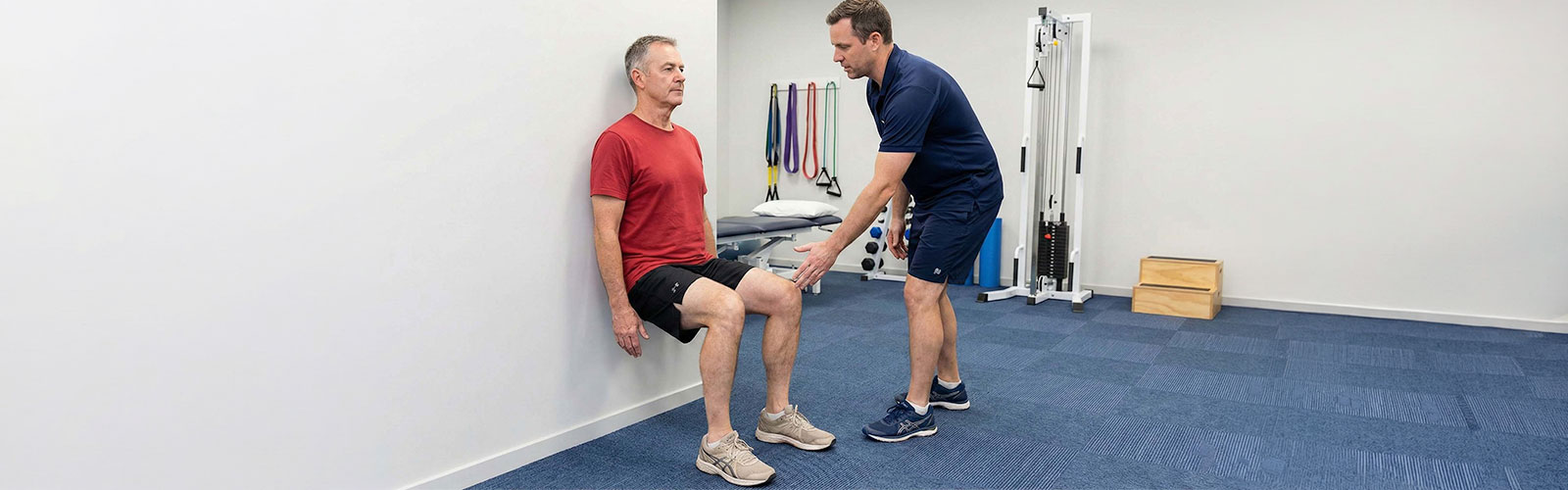
For Achilles, that might look like a calf raise hold. For patellar tendon, it might be a wall sit or a leg extension hold. For gluteal tendon, a side-lying hip abduction hold or a standing banded hold can work well. The goal is steady tension, calm breathing, and a pain level that feels acceptable.
If isometrics make symptoms flare for days, the dose is too high. If they feel easy and calm, you’re ready to progress.
Stage 2: Heavy slow resistance — the tendon builder
Heavy slow resistance is exactly what it sounds like: lifting a challenging load with slow, controlled reps. This is where tendons really build tolerance.
Slow reps matter because they keep time under tension high and stop momentum from doing the work. A typical tempo might be three seconds down, a brief pause, then three seconds up. It’s not glamorous, but it’s effective.
For Achilles, this often becomes slow calf raises and seated calf work, progressing load steadily. For patellar tendon, slow squats, split squats, leg press or decline squats can be appropriate depending on irritability and technique. For gluteal tendon, slow hip hinges, step-ups, and targeted hip abduction strength are usually key.
The principle is consistent across all three: load the tendon in a way it can tolerate, then progress slowly over weeks.
The “pain rules” that keep you progressing
Tendon rehab shouldn’t be pain-free, but it also shouldn’t be reckless. A useful guide is that mild discomfort during exercise is acceptable if it settles within 24 hours and doesn’t escalate week to week. If you finish a session and the tendon is angry for two days, or morning pain ramps up significantly, you’ve done too much.
Consistency is the big secret. Tendons respond best to repeated exposures, not random heroic sessions. Small progressions — an extra rep, a small load increase, a slightly deeper range — beat big jumps every time.
Why stretching isn’t the main answer
Many people instinctively stretch a sore tendon. Stretching can feel good, but it often doesn’t address the core issue: the tendon needs better load tolerance. In some cases, aggressive stretching can irritate the tendon further, especially if it’s already sensitive.
Mobility still matters, but we use it strategically. For Achilles, ankle mobility can help, but the tendon still needs progressive calf strength. For hip, we focus on movement quality and avoid positions that compress the tendon early on. For patellar tendon, we often look at hip and ankle control so the knee doesn’t take everything.
The hidden driver: load management outside the gym
Tendons don’t just respond to your rehab exercises — they respond to everything you do. A sudden week of hills, a new sport season, extra gardening, or long days on your feet can be the tipping point.
Part of good rehab is adjusting the total weekly load so the tendon can adapt. That doesn’t mean doing nothing. It means being smart: keep moving, but reduce the biggest irritants while you build capacity.
Why 1-on-1 Exercise Physiology helps
Tendon rehab is simple in theory and tricky in real life. The right exercise, the right range, the right tempo, the right weekly dose — and the right progression speed for your body. That’s where one-on-one work makes a big difference.
At Inspire Fitness, an Exercise Physiologist will assess the tendon, your movement patterns, your training history, and the things in your life that keep poking the sore spot. We’ll pick the right starting point, coach clean technique, and progress you methodically from isometrics to heavy slow resistance. We’ll also help you keep training around it so you don’t lose fitness while the tendon settles.
What a realistic timeline looks like
Tendons usually improve gradually, not overnight. Many people feel early wins within a few weeks once the loading is right, but building real resilience often takes a few months of consistent training. That’s normal and it’s worth it. The aim isn’t to baby the tendon forever; it’s to make it robust again.
Ready to get on top of it?
If you’ve been stuck in the rest–flare-up loop, tendon training can be a game changer. With the right progression, most people return to walking, running, gym training and sport with far less pain and far more confidence.
If you want a personalised plan for Achilles, gluteal or patellar tendon pain, our Exercise Physiologists are here to help one-on-one.