
Ask most people over 50 about their exercise routine and you’ll hear about walking, maybe some resistance training, perhaps a swim or a bike ride. Almost nobody mentions balance training. It’s not that people think it’s unimportant — it’s more that it simply doesn’t occur to them as something you deliberately train, the way you’d train strength or cardiovascular fitness. Balance is treated as a fixed trait, something you either have or don’t, rather than a physical capacity that responds to practice in exactly the same way muscles respond to resistance.
This is a genuine blind spot, and it’s an important one to close. Balance is trainable, it declines predictably with age if left unaddressed, and the consequences of poor balance are significant enough that this deserves to be treated as a core pillar of exercise after 50, not an afterthought squeezed in if there’s time left at the end of a session.
The numbers on falls make the case plainly. Falls are the leading cause of injury-related hospitalisation in Australians over 65, and the risk begins climbing well before that milestone. One in three people over 65 will experience a fall in any given year, and the consequences extend well beyond the physical injury itself — a serious fall is one of the most common events that triggers a permanent loss of independence in older adults, whether through a fractured hip, a long and difficult recovery, or the fear and confidence loss that often follows even a relatively minor fall.
The encouraging part of this story is that falls risk is not simply a matter of bad luck or an inevitable consequence of ageing. Balance, like strength, responds to training. And the earlier you start building it deliberately, the more capacity you have banked before it becomes something you’re managing reactively rather than proactively.
What balance actually is
Balance feels like a single, simple thing, but it’s actually the coordinated output of three separate sensory systems working together in real time, constantly making tiny adjustments to keep you upright.
The vestibular system, housed in the inner ear, detects the position and movement of your head in space — whether you’re tilting, rotating, accelerating or decelerating. It’s the system responsible for that unmistakable disoriented feeling when you spin around too many times, and it plays a central role in maintaining stability during any movement that involves your head changing position relative to gravity.
The visual system contributes enormously to balance, providing information about your position relative to the environment around you. This is why balance tends to feel noticeably harder with your eyes closed — a large proportion of the balance equation is being handled visually, and removing that input forces the other systems to work considerably harder to compensate.
The proprioceptive system, sometimes called your body’s internal GPS, relies on sensory receptors in your muscles, tendons, joints and skin to constantly report information about where your limbs are in space, how much force is being applied through them, and how your joints are currently positioned. This is the system that lets you walk confidently on an uneven footpath without having to look down at every step, and it’s the system that tends to decline most significantly with age and inactivity — which is why it’s also the system that responds so well to targeted training.
Your brain integrates the information from all three systems continuously and sends out rapid correction signals to the muscles of your ankles, hips and trunk to make the constant micro-adjustments that keep you upright, whether you’re standing still, walking, or recovering from an unexpected trip or slip. Balance training, at its core, is about improving how effectively this entire system works together — sharpening the sensory input, speeding up the processing, and strengthening the muscular response that follows.
Why balance declines after 50
Balance doesn’t decline suddenly. It erodes gradually, often for years, before it becomes noticeable enough to prompt concern — which is exactly why it’s worth addressing proactively rather than waiting for a wobble or a near-fall to serve as the wake-up call.
Proprioceptive sensitivity declines measurably with age, meaning the sensory receptors in your joints and muscles become somewhat less precise at detecting subtle changes in position and load. This is a normal part of ageing, but it’s significantly accelerated by inactivity, since these receptors, like muscle tissue itself, respond to use and become less sensitive without regular challenge.
Muscle mass and strength decline with age through the process known as sarcopenia, and this has a direct and significant impact on balance. The muscles of the ankles, hips and trunk are responsible for executing the rapid corrective actions that prevent a stumble from becoming a fall. When these muscles weaken, not only is the corrective response slower to initiate, it’s also less forceful once it does occur — a combination that meaningfully increases fall risk independent of any change in the sensory systems described above.
Reaction time slows gradually with age as a normal feature of neurological ageing, affecting how quickly the brain can process sensory input and translate it into an effective muscular correction. This is one of the reasons why a stumble that would have been easily and unconsciously corrected at 30 can become a genuine fall at 65 or 70 — not because the person is fundamentally less capable, but because the window of time available to execute an effective correction has narrowed.
Vision changes, including reduced contrast sensitivity and slower adaptation to changing light conditions, reduce the quality of the visual information feeding into the balance system, particularly in situations like dim lighting, uneven outdoor terrain, or the transition between different light levels such as walking from a bright room into a darker hallway.
Vestibular function also tends to decline gradually with age, and certain medications commonly prescribed for other conditions can further affect vestibular and balance function as a side effect, which is worth being aware of and discussing with your GP if you notice changes in balance that coincide with a new medication.
Reduced activity levels compound all of the above. Many of the daily movement challenges that once maintained balance capacity almost incidentally — walking on uneven ground, carrying groceries while navigating stairs, playing sport, reaching and twisting during gardening or housework — become less frequent as lifestyles become more structured and sedentary with age. Without those incidental challenges, the balance system simply doesn’t receive the regular stimulus it needs to maintain its current capacity, let alone improve.
Why proprioception deserves special attention
Of the three sensory systems that contribute to balance, proprioception is arguably the most important to train deliberately, for a couple of practical reasons.
Unlike vision, which you can’t meaningfully train beyond what your eyesight allows, and unlike the vestibular system, which is more difficult to directly influence through exercise, proprioception responds robustly and relatively quickly to targeted training. Every time you challenge your body to maintain balance in a slightly unstable or unfamiliar position — standing on one leg, standing on an uneven surface, moving through a range of motion with your eyes closed — you are directly stimulating the sensory receptors responsible for proprioceptive feedback, and with consistent practice, those receptors and the neural pathways connecting them to your muscles genuinely become more efficient.
Proprioceptive training also has the useful property of transferring quite well to real-world function, because so many of the situations that lead to falls involve a sudden, unexpected proprioceptive challenge — a foot landing on an uneven surface, a trip over an unseen obstacle, a sudden shift in surface stability such as stepping from a footpath onto grass or gravel. Training your proprioceptive system to respond more quickly and effectively to exactly these kinds of unpredictable challenges is one of the most direct ways balance training reduces real-world falls risk, rather than simply improving performance on a specific balance test.
Single-leg stability: the most practical starting point
If there’s one single concept to build a balance training habit around, it’s single-leg stability, and there’s a simple reason why: walking itself is essentially a continuous series of single-leg balance challenges. Every step you take involves a brief period where your entire body weight is supported by one leg while the other swings through to the next step. If your single-leg balance is poor, this everyday, unavoidable movement pattern becomes a source of ongoing risk, happening thousands of times a day without you ever consciously thinking about it.
This is why single-leg balance exercises deliver such a strong return relative to the time they take, and why they form the backbone of most well-designed balance training programs. A simple single-leg stand — lifting one foot off the ground and maintaining balance on the other for a set period of time — is a genuinely useful and easily measurable starting point. Research has suggested that the ability to stand unassisted on one leg for around ten seconds is associated with meaningfully better outcomes across a range of health measures in older adults, making it a useful and motivating benchmark to work toward if you’re not currently there.
From that simple starting point, single-leg stability work can progress in a number of directions depending on current capacity, including standing on an unstable or slightly cushioned surface to increase the proprioceptive challenge, closing the eyes to remove visual input and force greater reliance on the vestibular and proprioceptive systems, adding controlled upper body or head movement while maintaining the single-leg position, or progressing to genuinely functional single-leg strength exercises like single-leg deadlifts, step-ups and split squats, which combine a balance challenge with a meaningful strength stimulus at the same time.
Building a balance training habit that actually sticks
The research on balance training is clear that consistency matters more than any single session’s difficulty, and this is genuinely good news, because it means a balance training habit doesn’t need to be a major undertaking to be effective.
Frequency tends to matter more than duration for balance training specifically. Several studies examining fall prevention programs in older adults have found that balance training performed at least two to three times per week produces meaningful improvements in balance measures and reductions in fall risk, and that these sessions don’t need to be lengthy to be effective. A well-structured ten to fifteen minute balance session, performed consistently several times a week, tends to produce better results over time than an occasional, longer session performed inconsistently.
Progressive challenge is just as important in balance training as it is in strength training. Balance capacity, like muscular strength, adapts to the demand placed on it, which means a balance exercise that felt genuinely challenging six weeks ago will likely feel considerably easier now if you’ve been practising it consistently — and that’s exactly the signal to progress to a more difficult variation, whether that’s a longer hold time, an unstable surface, closed eyes, or an added movement or cognitive challenge.
Integrating balance work into daily routines you already have is one of the most reliable ways to build genuine consistency. Standing on one leg while brushing your teeth, holding a single-leg position while waiting for the kettle to boil, or performing a few single-leg stands during television advertisement breaks are all small, low-effort ways to accumulate meaningful balance practice without requiring a dedicated block of time in an already busy schedule. These incidental moments add up meaningfully over weeks and months.
Combining balance work with strength training, rather than treating it as an entirely separate activity, is a highly efficient approach that reflects how balance and strength genuinely interact in daily function. Performing strength exercises in single-leg or otherwise less stable positions — a single-leg Romanian deadlift instead of a bilateral one, a split squat instead of a standard squat, a standing cable row instead of a seated row — builds strength and balance simultaneously, and tends to transfer particularly well to real-world movement because it more closely mirrors the demands of daily life.
Practical balance exercises to start with
A well-rounded balance training approach for someone over 50 typically progresses through several stages, and it’s worth working through these roughly in order rather than jumping straight to advanced variations before the foundational capacity is in place.
Static single-leg standing, held for as long as comfortably possible up to around 30 to 60 seconds per side, is the natural starting point for most people, and can be made easier by lightly touching a wall or bench for support if needed, or more challenging by folding the arms across the chest or closing the eyes once the basic position feels stable.
Heel-to-toe walking, placing one foot directly in front of the other as though walking along a tightrope, challenges dynamic balance in a way that closely mirrors the narrow base of support involved in normal walking, and is a particularly useful exercise for building confidence in gait-related balance specifically.
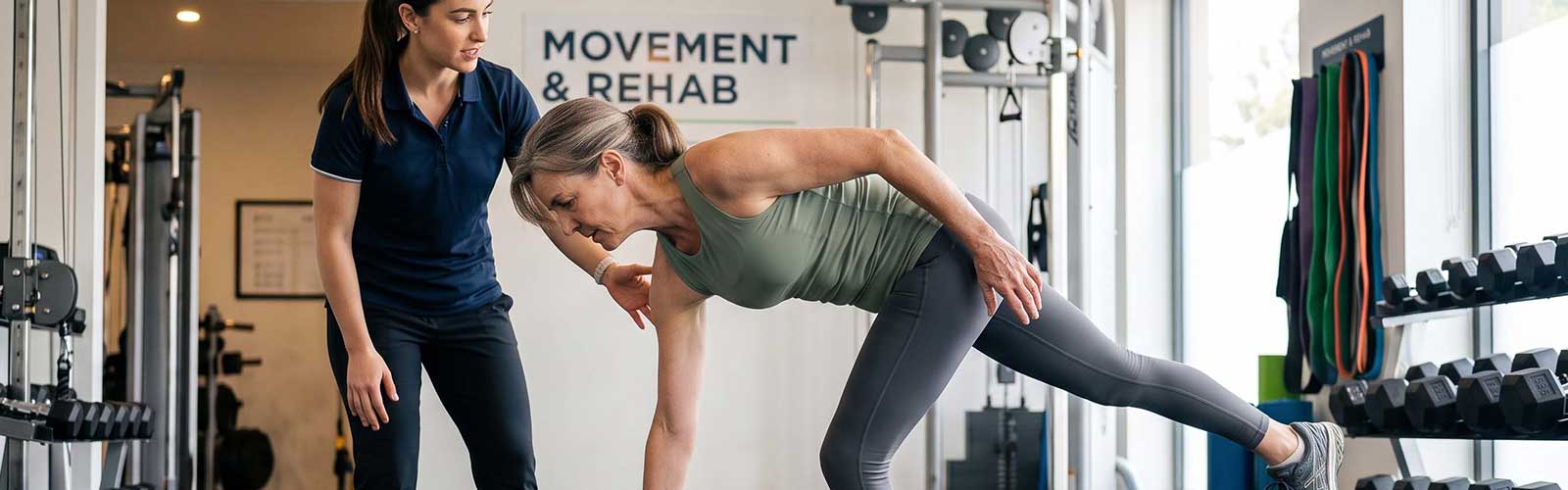
Single-leg reaching exercises, where you balance on one leg while reaching the opposite hand toward the ground, to the side, or behind you, add a dynamic, multi-directional challenge that closely reflects the kind of balance demands involved in everyday tasks like picking something up off a low shelf or reaching into the back seat of a car while standing.
Step-ups and step-downs onto a stable box or step, performed slowly and with control, build single-leg strength and balance simultaneously and translate directly to the real-world demand of managing stairs and kerbs confidently.
Tandem stance, standing with one foot directly in front of the other in a heel-to-toe position and holding that position for time, is a useful progression from single-leg standing that still challenges a narrow base of support while requiring slightly less absolute balance capacity than a full single-leg stand.
Balance work on unstable surfaces, using a foam pad, wobble cushion or similar equipment, adds a meaningful proprioceptive challenge once basic balance on a stable surface feels comfortable, though this progression is best introduced under guidance to ensure it’s appropriately matched to current capacity and doesn’t create unnecessary fall risk during the training itself.
Reactive balance drills, which involve deliberately introducing small, controlled perturbations or unexpected challenges — a gentle unexpected nudge, a sudden direction change during walking, or catching a lightly thrown ball while standing on one leg — are considered one of the more advanced and valuable forms of balance training, because falls in real life are almost always unexpected events, and training the body’s rapid corrective response to sudden challenges has shown particularly strong evidence for reducing real-world fall risk in research on older adults.
Why balance training deserves the same respect as strength training
There’s a tendency, understandably, to think of balance training as a gentler, less serious form of exercise compared to lifting weights or doing cardio — something almost remedial rather than a genuine training pursuit in its own right. This framing undersells both the physical demand of well-designed balance work and its genuine importance as a health outcome.
A challenging single-leg exercise performed on an unstable surface with the eyes closed is a legitimately demanding neuromuscular task, engaging the nervous system, the muscles of the ankle, hip and trunk, and the sensory systems all simultaneously in a way that few other exercises replicate. And in terms of outcomes that matter, balance training has as strong or stronger an evidence base for reducing serious injury and preserving independence in older adults as almost any other category of exercise, including a substantial body of research specifically examining structured balance and functional exercise programs as an effective strategy for reducing falls in adults over 65.
For people over 50, building genuine respect for balance training as a core training pillar — alongside strength, cardiovascular fitness and mobility, rather than an optional extra — is one of the more valuable shifts in mindset available, particularly given how directly it connects to maintaining independence, confidence and quality of life in the decades ahead.
How an Exercise Physiologist can help
Balance training benefits enormously from professional guidance, for a couple of practical reasons that are worth understanding.
The right starting point and progression rate depend heavily on your current balance capacity, any history of falls or near-falls, other health conditions that might affect balance such as diabetes, vestibular disorders or previous stroke, and any medications you’re taking that might influence balance function. An Exercise Physiologist can conduct a proper balance assessment, identify your specific areas of relative strength and weakness across the different systems involved, and build a program that progresses appropriately and safely from that individual starting point.
There’s also a genuine safety consideration in progressing balance exercises appropriately. Introducing an unstable surface, a closed-eye variation, or a reactive drill before someone has the underlying capacity to manage it safely can create real fall risk during the training itself, which is obviously counterproductive to the entire goal. A professional can judge this progression accurately and ensure appropriate safety measures, such as nearby support or spotting, are in place as more challenging variations are introduced.
At Inspire Fitness in Balwyn North, balance and falls prevention are a genuine focus for many of our clients over 50, and it’s an area where even a modest, consistent investment of time tends to produce results that clients notice quite quickly — a steadier feeling on uneven ground, more confidence navigating stairs, less hesitation stepping off a kerb. These might sound like small things, but they compound meaningfully into a greater sense of physical confidence and independence over time.
Balance is not something you either have or don’t have. It’s a capacity you can build, at any age, with the right approach. And given what’s at stake, it might be one of the best returns on investment available in your entire exercise routine.