
Unlock Better Movement Through Improved Hip Mobility.
Written by Lachlan Marr, Accredited Exercise Physiologist.
Do your hips feel stiff when you squat, lunge, walk, or exercise? Do you experience tightness through your hips, lower back, or legs that seem to limit your movement?
Restricted hip mobility is one of the most common movement limitations I see in the clinic. While many people focus heavily on building strength, mobility is what allows you to access the positions needed to move well in the first place.
Poor hip mobility can affect exercise technique, movement efficiency, balance, athletic performance, and may contribute to excessive stress on surrounding joints such as the knees and lower back.
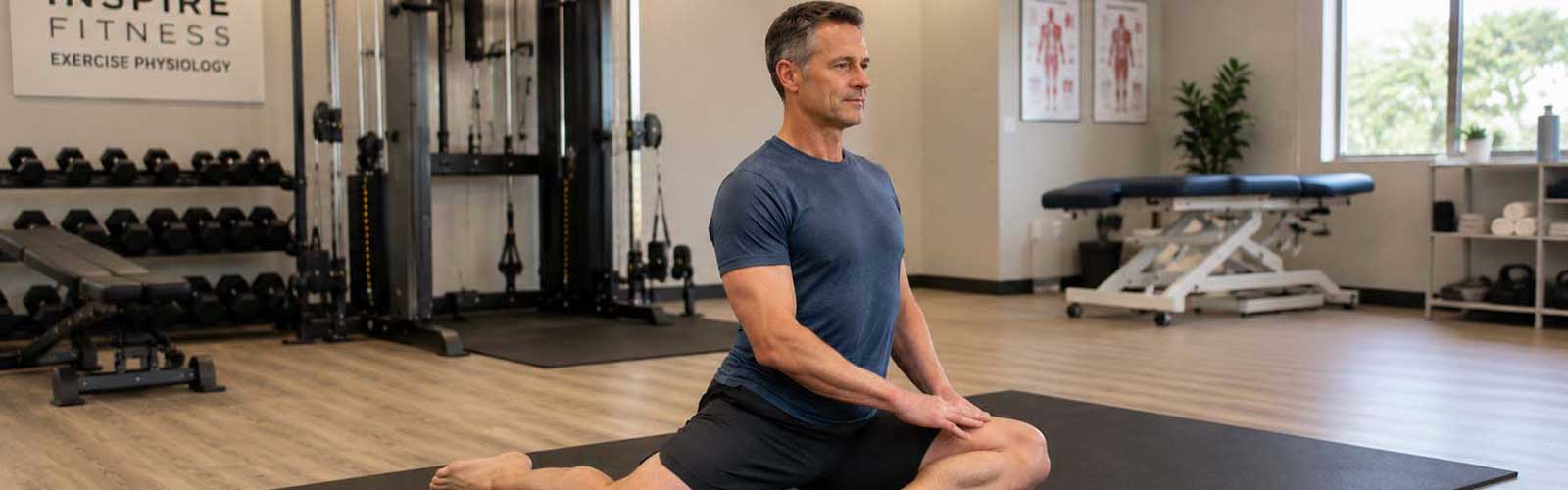
What Is Hip Mobility?
Mobility refers to the ability to move a joint through its available range of motion while maintaining strength, stability, and control. Unlike flexibility, which describes the passive length of muscles and soft tissues, mobility reflects how well a person can actively access and control movement throughout a joint’s available range.
The hip is a highly mobile ball-and-socket joint that allows movement in multiple directions, including flexion, extension, internal and external rotation, as well as abduction and adduction.
Adequate hip mobility is important for efficient movement during activities such as squatting, lunging, running, and changing direction. In particular, hip flexion and internal rotation play key roles in maintaining movement quality, joint alignment, and overall function.
Why Hip Mobility Matters
The hips play a central role in almost every lower-body movement. They act as a link between the legs, pelvis, and trunk, helping transfer force efficiently during activities such as squatting, running, jumping, lifting, and changing direction.
When hip mobility is limited, the body often compensates by borrowing movement from other areas, particularly the lower back and knees. Over time, these compensations can reduce movement quality and increase stress on surrounding tissues.
Common signs of restricted hip mobility include:
- Reduced squat depth
- Excessive forward lean during squats
- Lower back rounding
- Increased stress through the knees or lower back
- Poor movement efficiency during training or sport
- Feelings of tightness and/or stiffness through the hips, glutes, hamstrings, adductors, calves, or lower back
- Reduced balance, stability, and control during movement
Because the body functions as an interconnected system, limitations at the hips rarely affect the hips alone. Improving hip mobility can often enhance movement quality throughout the entire kinetic chain.
How to Assess Your Hip Mobility
Deep Squat Test – A simple self-assessment is the deep squat.
- Stand with feet shoulder-width apart.
- Raise your arms overhead.
- Squat as deeply as possible while keeping your heels on the ground.
Potential indicators of restricted hip mobility during the deep squat include excessive forward trunk lean, difficulty reaching parallel depth, lower back rounding, knees collapsing inward, and excessive weight shifting onto the toes.
90/90 Hip Rotation Test
The 90/90 Hip Rotation Test assesses hip internal and external rotation, both of which are important for efficient movement during activities such as squatting, lunging, running, and changing direction.
How to perform the test:
- Sit on the floor with one leg positioned in front of you and the other behind you, both bent to approximately 90 degrees.
- Maintain an upright posture through your trunk.
- Assess your ability to comfortably achieve and maintain the position on both sides.
- Progress by rotating from one side to the other without using your hands for assistance.
Potential indicators of reduced hip mobility during the 90/90 Hip Rotation Test include difficulty achieving the position, excessive leaning or trunk compensation, significant side-to-side differences, pain or discomfort during the movement, and limited internal or external hip rotation.
Thomas Test
The Thomas Test is commonly used to assess flexibility and mobility of the hip flexor muscles, including the iliopsoas and rectus femoris. Tightness in these muscles can contribute to reduced hip extension and altered movement mechanics.
How to perform the test:
- Sit at the edge of a treatment table, bench, or firm bed.
- Slowly lie back while bringing one knee towards your chest.
- Hold the knee firmly against your chest and allow the opposite leg to relax.
Potential indicators of reduced hip mobility during the Thomas Test include the hanging thigh remaining elevated above the surface, excessive knee extension of the hanging leg rather than maintaining a bent position, anterior pelvic tilt or excessive lower back arching, and noticeable side-to-side differences between legs.
Key Exercises to Improve Hip Mobility
While there are many exercises that can be used to improve hip mobility, a small number of well-selected movements can address the most common mobility limitations affecting daily activities, exercise performance, and movement quality. Effective mobility training should not only improve range of motion but also develop strength and control within those ranges.
90/90 Hip Rotations
The 90/90 Hip Rotation is one of the most effective exercises for improving both internal and external hip rotation, which are essential for squatting, lunging, walking, running, and changing direction. It also develops active control through these ranges, helping to improve overall movement quality.
Prescription: 2–3 sets of 8–10 repetitions per side.
Couch Stretch
The Couch Stretch targets the hip flexors and quadriceps, which commonly become stiff following prolonged periods of sitting. Improving hip extension mobility can assist with walking, running, lifting mechanics, and reducing compensatory movement through the lower back.
Prescription: Hold for 30–60 seconds per side.
Loaded Butterfly Stretch
The Loaded Butterfly Stretch is an effective way to improve adductor mobility while simultaneously developing strength and control in the end range of hip abduction. This can be particularly beneficial for improving squat depth, lower-body movement quality, and overall hip function.
Prescription: Hold for 30–60 seconds, applying gentle downward pressure as tolerated.
Elevated Pigeon Stretch
This exercise targets the gluteal muscles and external hip rotators, areas that commonly contribute to feelings of hip stiffness. Improving mobility in these tissues can enhance hip rotation and reduce movement compensations during lower-body activities.
Prescription: Hold for 30–60 seconds per side.
Deep Squat Pry
The Deep Squat Pry is a functional mobility exercise that promotes improved hip flexion, adductor mobility, ankle mobility, and squat positioning. It can be particularly beneficial for individuals who struggle to achieve comfortable squat depth while maintaining good movement mechanics.
Prescription: Hold for 30–60 seconds, gently shifting weight and exploring available ranges of motion.
Additional Strategies – Self-myofascial release
Self-myofascial release techniques such as foam rolling and spiky ball work may help reduce short-term feelings of stiffness around the hips and lower body by modulating tissue tone and improving perceived movement quality, rather than creating lasting structural change.
Common areas include the plantar surface of the feet, gluteals, hip flexors, adductors, and TFL. The feet are particularly relevant as part of the superficial back line (SBL), a myofascial chain that connects the plantar fascia through the posterior chain, including the calves, hamstrings, and spine.
While these techniques may be useful for symptom modulation, lasting improvements in hip mobility are best achieved when they are combined with active mobility work and progressive strength training through full ranges of motion, which reinforces new ranges and supports long-term movement control.
Hip Mobility, Movement Quality, and Long-Term Musculoskeletal Health
Adequate hip mobility is an important component of efficient movement, exercise performance, and long-term musculoskeletal health. As a key link between the lower limbs and trunk, the hips contribute significantly to force production, force absorption, balance, and movement control during both daily activities and exercise.
When hip mobility is restricted, the body often compensates by increasing movement through neighbouring joints, particularly the knees and lower back. Over time, these compensatory strategies can alter movement mechanics, reduce efficiency, and increase stress on surrounding tissues.
Improving hip mobility may contribute to:
- Improved movement quality and exercise technique
- Enhanced squat, lifting, running, and jumping mechanics
- Greater movement efficiency and control
- Improved force production and absorption
- Reduced compensatory movement patterns
- Better overall physical function
- Improved balance, proprioception and reduced falls risk
- Reduced risk of injury
Importantly, mobility is only one component of optimal movement. Long-term outcomes are best achieved when mobility is supported by appropriate strength, stability, and motor control training.
By identifying and addressing hip mobility restrictions, individuals can improve movement capacity, optimise exercise technique, and reduce unnecessary stress on surrounding joints and tissues. If stiffness, movement limitations, or discomfort are affecting your training, work, sport, or daily activities, an assessment with an Accredited Exercise Physiologist can help identify contributing factors and guide an individualised management plan.
For more information please call contact us at Inspire Fitness on 9857 3007 and speak with one of our friendly Exercise Physiologists. At Inspire we design an individualised training program which address mobility deficiencies as described in this article.