
By Michael Richmond AEP
Why the ability to move quickly may matter just as much as how much force you can produce.
When people think about ageing, they often think about losing strength. It’s a common assumption that getting older simply means becoming weaker, and that preserving muscle mass is the main physical challenge. While strength does matter, it may not be the whole story.
One of the most important changes that occurs with ageing is a decline in muscle power — the ability to produce force quickly. While strength helps you lift, carry and push, power helps you react, recover and move with speed when life demands it. It’s a concept we discuss often with clients at Inspire Fitness, because many of the things’ people value most balance, confidence and independence depend on it. In many ways, it is power, not just strength, that underpins confident and independent movement.
This becomes especially relevant in everyday tasks we rarely think about until they become difficult: getting out of a low chair, climbing stairs, catching yourself after a trip, stepping quickly to avoid losing balance, or crossing a road before the lights change. These are not simply tests of how strong your muscles are, but how rapidly they can generate force.
Research has suggested that muscle power may decline earlier, and often more rapidly, than strength itself (Ferretti et al., 1994). Importantly, this decline cannot be explained by muscle size alone. Changes in neuromuscular function and the ability to activate muscle quickly appear to play a major role, which may help explain why some people feel slower or less steady even when they don’t necessarily feel weak.
Why Power Matters for Healthy Ageing
Power has a strong relationship with function. In fact, some studies suggest lower limb power may be more closely related than strength to activities such as stair climbing, rising from a chair and walking performance (Bassey et al., 1992).
In my practice, many people don’t also say they feel “weak”. More often, they describe feeling slower, less responsive, or less confident with movement. They notice they take longer getting up from the couch, feel more cautious on uneven ground, or don’t recover from stumbles as automatically as they once did.
Often, those changes reflect declining power.
That distinction matters, because if we only think about ageing through a strength lens, we may miss an important part of the picture.
Strength and Power Aren’t the Same Thing
A common question I get asked by clients at Inspire is “what is the difference between strength and power” and although they are related, they’re not interchangeable. Strength refers to the amount of force a muscle can generate and Power combines force with speed.
A person may have enough strength to stand from a chair but doing so quickly and confidently, particularly when balance is challenged and relies heavily on power.
That difference becomes increasingly important with ageing because many real-world situations are time sensitive. Falls prevention, for example, often depends less on maximal strength and more on the ability to generate a rapid corrective response.
In that sense, power is not just a performance concept. It is a functional one.
Can You Train Power?
Absolutely and often much more safely and effectively than people expect.
When people hear power training, they often picture explosive athletic movements or high-impact exercises. But in a healthy ageing context, power training doesn’t mean training like an athlete. It means deliberately training the ability to generate force quickly, in ways that translate to everyday life.
That might begin with something as simple as changing how an exercise is performed, not just what exercise is chosen.
For example, a sit-to-stand can become a power exercise when the focus shifts from simply standing up to standing up quickly with intent, while controlling the lowering phase on the way down. That “fast up, slow down” approach can challenge rapid force production while still being highly accessible.
The same principle can be applied across a range of exercises.
Step-ups can be used not just for strength, but to train powerful leg drive and stair-climbing capacity. Split squats can help develop force production through each leg individually, which is highly relevant for gait and balance recovery. Calf raises, often overlooked, can play an important role in restoring propulsion for walking and improving push-off power.
As capacity improves, power-focused training may progress to more dynamic functional tasks.
This might include:
- Rapid Sit-to-stand intervals: building repeated power and muscular endurance
- Step-up to knee drive drills: targeting balance, coordination and lower-limb power
- Medicine ball chest passes or rotational throws: where appropriate, to develop upper-body and trunk power
- Low-level plyometric-style drills: such as controlled heel raises with quick concentric drive or gentle assisted pogo-style movements for suitable individuals
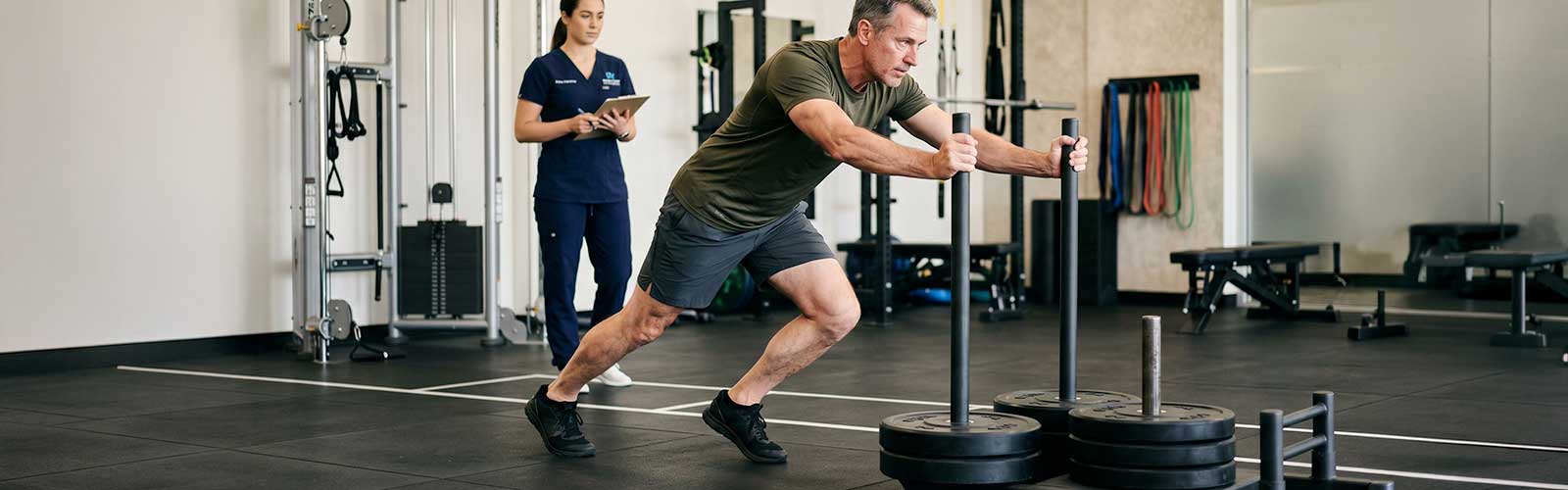
- Weighted sled pushes or resisted walking: which can train forceful gait mechanics in a very functional way
Reactive exercises can also be a powerful part of this approach.
Because preventing falls often depends on responding quickly, not just being strong, power training may include drills that challenge reaction time and rapid postural responses.
Examples might include:
- Reactive stepping in response to a cue
- Multidirectional stepping patterns
- Obstacle negotiation drills
- Change-of-direction tasks
- Dual-task exercises combining movement with cognitive challenge
For some individuals, we may also incorporate traditional resistance exercises performed with a power emphasis, such as:
- Leg press with controlled fast concentric intent
- Cable rows performed explosively through the pull phase
- Kettlebell deadlift patterns focused on hip drive
- Trap bar lifts or loaded carries, where appropriate
Importantly, the goal is not speed for speed’s sake, it is training the nervous system and muscles to produce force rapidly and efficiently in ways that support real-world function, as power training is not simply “moving faster” it is targeted, progressive training of a physical quality closely linked to mobility, balance and independence.
And like strength, it can be scaled to the individual.
For one person, power training may begin with faster chair rises. For another, it may involve advanced reactive stepping and loaded functional drills. The principles are the same, only the starting point changes.
That is where tailored Exercise Physiology can make a real difference.
Rethinking What “Ageing Well” Means
We often hear about staying strong as we age, and rightly so. Strength training is enormously valuable.
But perhaps a better question is not only “How do I stay strong?” but also “How do I stay powerful?”
How do I maintain the quickness, responsiveness and movement confidence that support everyday life?
That shift in thinking can change how we approach exercise.
Rather than viewing exercise purely as building muscle or preventing decline, it becomes about maintaining capability, preserving the physical qualities that allow you to keep doing the things that matter.
- Walking confidently
- Travelling independently
- Playing with grandchildren
- Recovering from a stumble
- Remaining active on your terms
- That is what healthy ageing is really about.
A Final Thought
One of the biggest myths about ageing is that slowing down is simply inevitable. While some change is normal, many of the physical qualities associated with independence can be trained, including power.
At Inspire Fitness, this is why we often think beyond traditional strength training when helping people age well. Because sometimes improving how quickly you can move can matter just as much as improving how much you can lift.
And that may be one of the most overlooked ideas in healthy ageing.
References
Bassey, E. J., Fiatarone, M. A., O’Neill, E. F., Kelly, M., Evans, W. J., & Lipsitz, L. A. (1992). Leg extensor power and functional performance in very old men and women. Clinical Science, 82(3), 321–327.
Ferretti, G., Narici, M. V., Binzoni, T., Gariod, L., Le Bas, J. F., Reutenauer, H., & Cerretelli, P. (1994). Determinants of peak muscle power: Effects of age and physical conditioning. European Journal of Applied Physiology, 68, 111–115.
Bemben, M. G., & McCalip, G. A. (1999). Strength and power relationships as a function of age. Journal of Strength and Conditioning Research, 13(4), 330–338.
Evans, W. J. (2000). Exercise strategies should be designed to increase muscle power. The Journals of Gerontology Series A, 55(6), M309–M310.