
Written By: Michael Richmond (Accredited Exercise Physiologist)
The Challenge After Stroke
Every year, stroke affects thousands of Australians and for many, the journey doesn’t end when they leave hospital. In 2023, around 45,800 Australians experienced a stroke, equating to one every 11 minutes (Stroke Foundation, 2023).
Difficulties with walking and balance are among the most common long-term challenges associated with having a stroke. This often leading to a higher risk of falls, reduced confidence, and a loss of independence with people who have suffered a stroke.
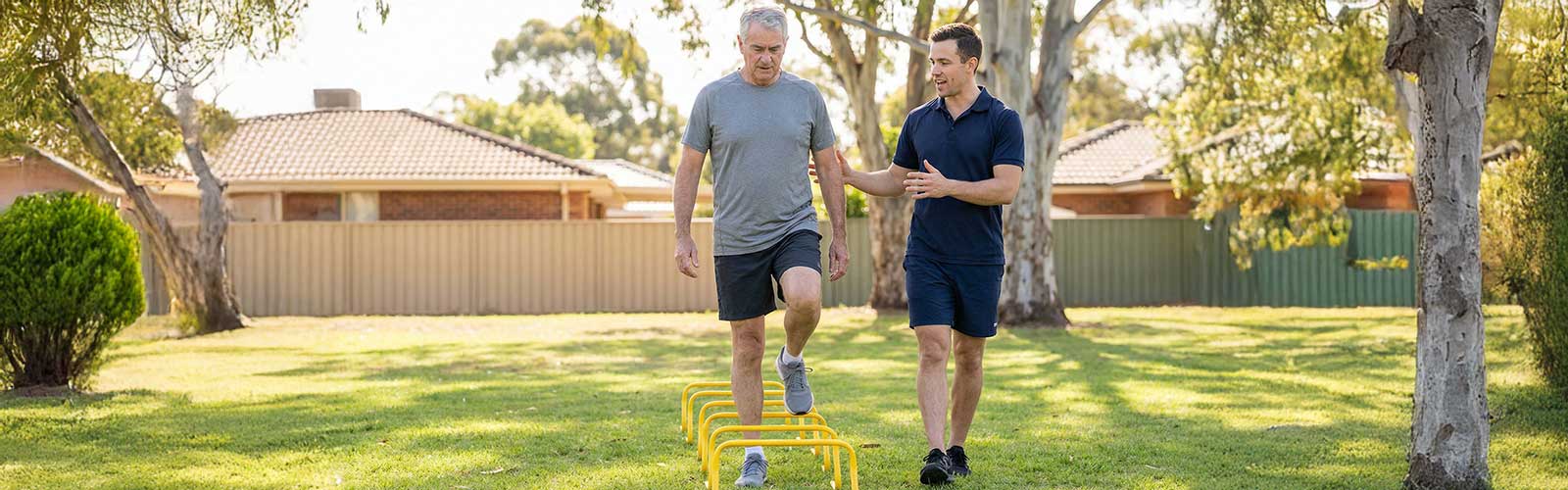
In my work as an Accredited Exercise Physiologist in Balwyn, a large proportion of my neurological caseload involves people living with the long-term effects of stroke. Many clients present months and sometimes years after discharge from hospital, still struggling with gait confidence, balance, and fear of falling. This article reflects not only the research evidence, but the clinical patterns I see every week in practice.
Stroke survivors commonly experience:
- Weakness on one side of the body
- Shuffling or uneven walking patterns
- Poor coordination and slower reaction times
- Increased risk of falls
- Reduced independence and confidence
These challenges affect not only mobility, but overall quality of life (Winstein et al., 2016).
How Exercise Physiology Helps
Exercise Physiologists use exercise as medicine, prescribing targeted, progressive programs that rebuild strength, retrain walking, and restore balance in a safe, evidence-based way.
Recovery is driven by neuroplasticity, the brain’s ability to reorganise and relearn movement through repeated, meaningful practice (Kleim & Jones, 2008). With the right type and dose of exercise, the brain forms new pathways that support better walking and postural control.
Research consistently shows that structured programs work. A systematic review found that completing at least one hour of balance training and 30 minutes of gait training, three to five times per week, significantly improves walking ability and balance after stroke (An & Shaughnessy, 2011). Another trial demonstrated that adding specialised balance training improved weight-bearing and pelvic movement, even months after stroke (Yavuzer et al., 2006).
The 5 Keys to Effective Stroke Rehabilitation
Our clinical approach follows principles proven to support brain and body recovery:
- Repetition (Massed Practice) – high volumes of meaningful practice reinforce new motor pathways (Langhorne et al., 2011).
- Task-Specific Training – practising the exact movements you want to improve, such as walking, stair climbing, or sit-to-stands (Winstein et al., 2016).
- Progressive Challenge – exercises become more demanding as strength, balance, and confidence improve (Kwakkel et al., 2015).
- Goal-Oriented Practice – linking training to real-world goals such as gardening, shopping, or playing with family (Bosch et al., 2014).
- Consistency – structured sessions over weeks and months to consolidate gains (Veerbeek et al., 2014).
What an EP-Led Program Looks Like in Practice
1. Strength for Stability
Weakness in the legs and trunk is common after stroke and directly affects walking safety. In my sessions, this typically includes:
- Sit-to-stands to restore independence with rising from chairs
- Step-ups to train stair climbing and single-leg stability
- Bridges, calf raises, split-squats, and hip strengthening exercises to improve lower-limb control for gait
- Exercise selection is always matched to each client’s goals and current ability.
2. Balance Retraining
Improving balance reduces falls risk and builds confidence in everyday movement. Programs often involve:
- Static balance drills such as tandem stance and reduced-base of support
- Dynamic balance tasks like marching, obstacle stepping, and directional changes
- Dual-task training, where clients balance while turning, carrying objects, or responding to cues, reflecting real-world demands.
3. Gait Retraining
Walking practice is central to recovery. In my clinical work, gait retraining commonly includes:
- Overground walking drills focusing on stride length, toe clearance, and symmetry
- Targeted muscle control, particularly through the hip flexors, dorsiflexors, and gluteal.
- Treadmill training, sometimes with body-weight support, to allow safe, high-repetition walking practice.
4. Functional Practice and Endurance
Exercises are always linked back to daily life. E.g. standing from a chair, navigating stairs, or walking safely in the community. Aerobic conditioning through interval walking or cycling helps manage fatigue while gradually improving endurance and cardiovascular health (Billinger et al., 2015).
Evidence in Action: A Clinical Snapshot
One client I currently work with is a 50-year-old male who experienced a stroke affecting his right side. When he commenced Exercise Physiology sessions with me, he relied heavily on a single-point stick for most mobility and lacked the confidence and physical capacity to drive independently.
Through a structured, EP-led program focusing on:
- progressive lower-limb strengthening,
- targeted balance retraining, and
- task-specific gait practice,
we have gradually reduced his reliance on the walking aid. Over time, his walking symmetry, stability, and confidence have improved to the point where he now uses the stick only intermittently and has successfully returned to independent driving.
For this client, regaining mobility was not just about walking further, it was about reclaiming independence in daily life. This outcome reflects what is possible when evidence-based exercise principles are applied consistently and tailored to the individual.
Measuring Progress That Matters
Structured exercise programs consistently improve:
- Walking speed
- Endurance
- Balance and stability
Outcome measures such as the Timed Up and Go (TUG), 6-Minute Walk Test (6MWT), and 10-Metre Walk Test are routinely used in our service to track progress and demonstrate meaningful, objective change (Winstein et al., 2016).
How This Looks in Our Service
At Inspire Fitness, stroke rehabilitation is delivered through individualised Exercise Physiology programs that integrate strength, balance, and gait retraining in a safe, supportive gym environment. Where appropriate, we collaborate with physiotherapists, GPs, and neurologists to ensure exercise prescription aligns with each client’s broader medical management.
This multidisciplinary, community-based model helps bridge the gap between hospital rehabilitation and long-term independence.
The Takeaway
Stroke recovery is a journey, regaining gait and balance is central to independence. With guidance from an Accredited Exercise Physiologist, stroke survivors can:
- Walk more confidently
- Reduce their risk of falls
- Improve strength and endurance
- Reclaim independence in daily life
As an Exercise Physiologist, one of the most rewarding aspects of my role is watching clients regain confidence in their movement, not just in the gym, but in everyday life. Seeing someone transition from fear of falling to confidently walking in the community reinforces the power of evidence-based exercise as a cornerstone of stroke recovery.
References
An, M., & Shaughnessy, M. (2011). The effects of exercise-based rehabilitation on balance and gait for stroke patients: A systematic review. Journal of Neuroscience Nursing, 43(6), 298–307.
Billinger, S. A., et al. (2015). Physical activity and exercise recommendations for stroke survivors. Stroke, 45(8), 2532–2553.
Bosch, J., et al. (2014). Does task-oriented practice improve motor recovery after stroke? Clinical Rehabilitation, 28(9), 841–853.
Kleim, J. A., & Jones, T. A. (2008). Principles of experience-dependent neural plasticity. Journal of Speech, Language, and Hearing Research, 51(1), S225–S239.
Kwakkel, G., et al. (2015). Effects of augmented exercise therapy time after stroke. Stroke, 35(11), 2529–2539.
Langhorne, P., et al. (2011). Stroke rehabilitation. The Lancet, 377(9778), 1693–1702.
Veerbeek, J. M., et al. (2014). Evidence for physical therapy post-stroke. PLoS ONE, 9(2), e87987.
Winstein, C. J., et al. (2016). Guidelines for adult stroke rehabilitation and recovery. Stroke, 47(6), e98–e169.
Yavuzer, G., et al. (2006). The effects of balance training on gait late after stroke. Clinical Rehabilitation, 20(11), 960–969.