
The evidence points one way — strength and walking reduce pain and improve function.
If your joints are sore, rest feels logical — here’s why it backfires
When knees or hips ache, it’s natural to pull back. A few easier days can help, but long stretches of “I’ll wait until it stops hurting” usually make joints stiffer, muscles weaker and everyday tasks harder. Osteoarthritis responds best to the right kind of load: thoughtful strength training and regular walking that teach your joints to tolerate life again. You don’t need hero workouts. You need the right movements, the right dose, and a steady build.
What “load” actually means for arthritic joints
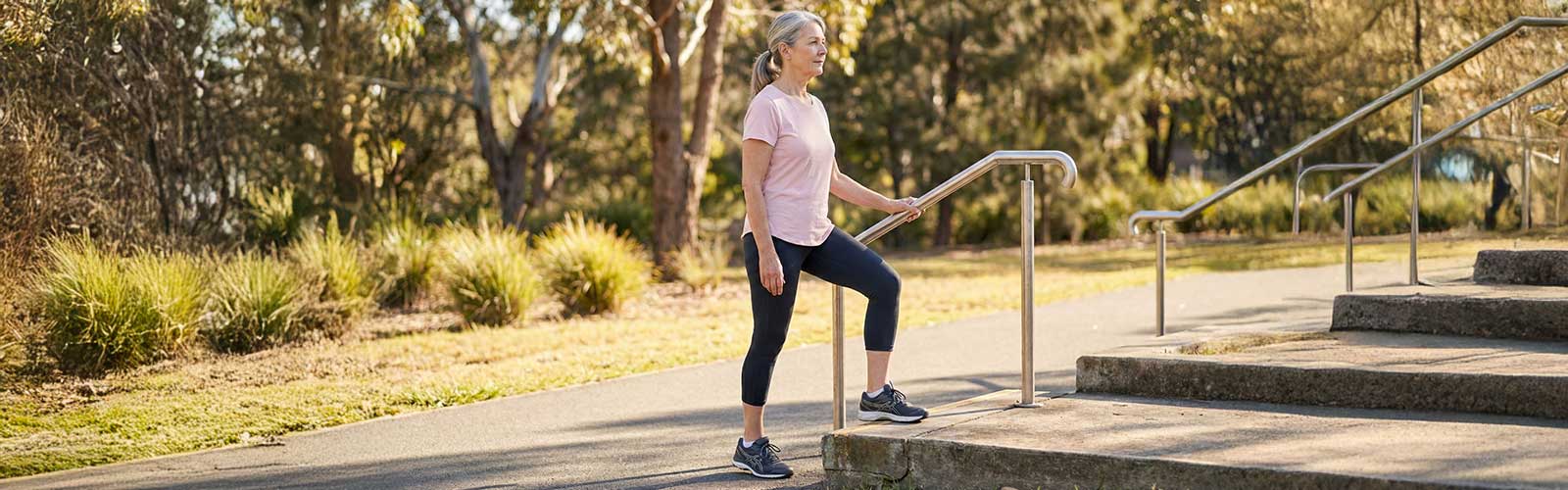
Load is simply controlled work your body can recover from. For osteoarthritis, that means movements that spread force through strong muscles rather than dumping it into grumpy cartilage. Think of a well-coached squat to a chair, a hip hinge that lets glutes and hamstrings do their job, a supported step-up that quietly builds confidence on stairs, or a brisk walk that gets joints warm without flogging them. Each small exposure tells the joint, “this is safe,” and capacity grows.
Why walking and strength work help (in plain English)
Walking increases joint lubrication, improves circulation to the tissues that support your joints, and lifts general fitness so day-to-day activities feel easier. Strength work adds the missing scaffolding. When thigh, hip and calf muscles are stronger, your knee or hip shares the load more evenly and pain usually settles. Over time, people report fewer “pinch” moments, better balance, more confidence on slopes, and less swelling after a busy day.
How to start when you’re stiff and wary
Begin where your body says “yes.” That might be ten minutes of flat walking at a pace where you can still chat, or two sets of easy sit-to-stands from a dining chair. Keep sessions short and repeatable. Aim for a gentle “exercise ache” that settles within twenty-four hours, not a spike that lingers for days. If pain flares, you haven’t failed — you’ve learned your current line. Pull the dose back a touch and keep the habit.
A simple walking framework that works
Pick two or three routes you like — a loop around the block, a local sports oval, a beach path — and alternate them through the week. Walk most days at a “somewhat hard” effort where breathing is up but you can still hold a conversation. Add a minute or two every few outings. If your joint is particularly irritable, split your walk into two shorter strolls. Hills are fine when you’re ready; start with gentle gradients and smooth paths.
Strength that supports sore knees and hips
Prioritise movements you’ll use in real life. Sit-to-stand variations build squat strength without deep knee angles you can’t control. Hip hinges with a dowel or light kettlebell shift effort into the big posterior muscles and away from painful joint surfaces. Step-ups to a low box re-train single-leg control for stairs and curbs. Calf raises help push-off when walking, while simple side-lying or banded hip work steadies the knee from the outside. Keep reps smooth, ranges comfortable and rests long enough that quality never nosedives. When that feels easy, nudge the dial with an extra rep, a slower lowering phase or a few more seconds of walking — tiny steps that joints tolerate beautifully.
Managing pain and flare-ups without losing momentum
Expect good weeks and grumpy ones. On good weeks, take small wins — a minute longer on the oval, a touch deeper to the chair, a third set when energy is high. On grumpy weeks, keep the ritual and change the dose. Swap hills for flats, shorten the walk but keep the frequency, choose higher-range movements with lighter loads, and lean into recovery: sleep, hydration and a few minutes of gentle mobility for ankles, hips and mid-back. Progress over a month matters far more than any single day.
Knees, hips and the “which comes first?” puzzle
Sore knees often reflect hips that aren’t pulling their weight and ankles that don’t move freely. Sore hips often reflect stiff backs and under-used glutes. That’s why isolated rest rarely shifts the needle. When we re-balance the system — strong hips and thighs, steady trunk, easier ankle movement, regular walking — the sore spot stops doing all the work. The joint hasn’t “worn out”; it has been overloaded. We change the load and the experience changes with it.
Why working 1-on-1 with an Exercise Physiologist helps
Generic machine circuits can’t read your history, your fear of flare-ups or the realities of your week. In a one-on-one session we listen first, test what matters — strength, balance, mobility, walk tolerance — and then pick variations that feel good in your body today. We coach technique so muscles take the strain, not your sore joint, set progressions you can actually recover from, and make on-the-day adjustments if sleep, stress or swelling are up. Across the weeks you’ll see objective wins: easier stairs, longer walks before discomfort, stronger sits-to-stands, better balance on uneven ground and a sense that your joint belongs to you again.
What a realistic twelve weeks looks like
In the first fortnight we calm things down and build trust with short walks and simple strength you can do on your worst day. Weeks three to six we grow capacity with slightly longer walks, slightly deeper ranges and one extra set where it’s comfortable. Weeks seven to twelve we add small touches of power and confidence — a quicker step-up, a firmer push-off, a slightly hillier route — always inside an acceptable discomfort window. The win isn’t a perfect scan; it’s waking up less stiff, doing more of what you love and feeling in charge of your joint again.
Ready to take the first step?
You don’t need a pain-free day to start. You need a plan that respects your joint, a pace that matches your life, and a coach who meets you where you are. Load — the right kind, in the right amount — is your way forward.
If you’d like a program designed around your osteoarthritis and your week, our Exercise Physiologists would love to help — one-on-one, from first session to full return.